For this entry, I made two recipes. Neither of them were especially good, but I don't blame the people who posted the original recipes or any of the traditions they came from, I blame myself and my propensity for Googling things that might kill me.
This is actually the third time I’ve cooked a meal from Malta. The first time, I cooked the meal and then just did not write the blog post. Years went by.
Imquarrum (also called Imqarrun il-forn) is descended from a dish served in Sicily, but the Maltese have adopted it as a traditional staple. The key to making this dish is to be patient.
Showing posts with label Sub-Saharan Africa. Show all posts
Showing posts with label Sub-Saharan Africa. Show all posts
I must have been in the mood for simple food this week, because I did enjoy our culinary journey into the little nation of Malawi. Now I say "simple" but these recipes weren't simple in taste--yes, the ingredients were basic, but they were still a nice combination of flavors.
Fish is really important to Malawian cuisine--remember from my last post that 1/3rd of Malawi's area is occupied by a lake. But I just didn't find a whole lot of fish options online (I know there have to be some out there, but I didn't have any luck) and with only one exception my kids hate fish anyway, so I settled on a chicken dish and, just because I did need some small way to torture my children, that cornmeal porridge stuff that everyone hates.
Here are the recipes I chose:
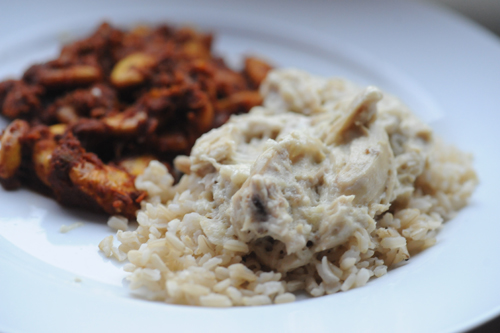
Nkhuku Ya Sabola. Spiced chicken curry made with tomatoes and potatoes.
Nsima. A polenta-like porridge made from cornmeal and butter.
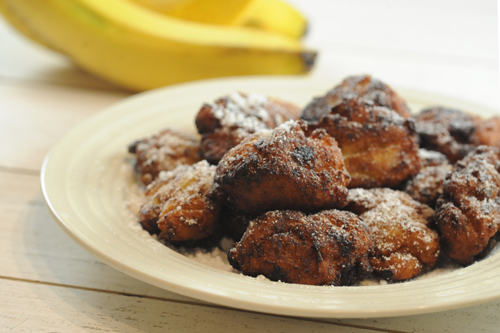
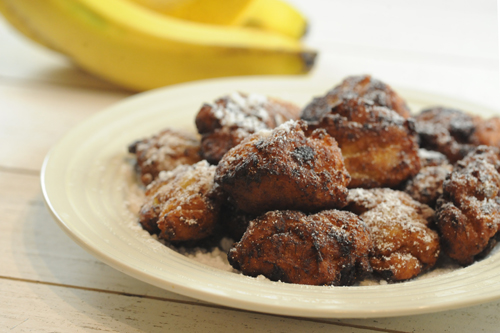
Banana fritters. Yes, something deep fried. Because I really needed the calories.
So let's face it, any recipe with the word "curry" in the title is going to be tasty by default, because, you know, curry. Of course the funny thing about Indian curry is it almost never has actual curry powder in it--or if it does, it's really a mixture of spices you put together in your own kitchen, which sort of fall under a generic umbrella of "curry" spices. Lots of other nations, though, make curries that get most of their flavor from a pre-mixed commercial curry powder, which is true for this Malawian chicken.
Like many African recipes, this one is simple to make and has only a handful of ingredients (recipe below).
First, season the chicken with salt and fry in oil over medium heat until browned on all sides. Remove from the heat and transfer to a large pot.
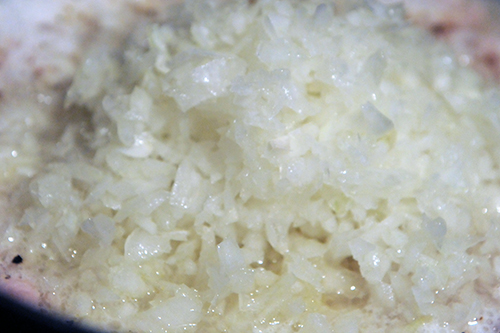
If there's any excess oil, pour it off and then use the remaining oil to saute the the onions.
When the onions are translucent, add the tomatoes, chili pepper, thyme and curry powder.
Cook the spices until fragrant, then add the water and stock. Bring to a boil, then transfer to the pot with the chicken. Let simmer uncovered for 45 minutes. Add the potato cubes and cook for another 15 minutes, or until the potatoes are tender. Season with a little more salt and pepper and serve.
I enjoyed this recipe, though my kids of course were ho-hum as they always are about anything that contains, you know, actual vegetables. So they spent a lot of time removing each individual little bit of onion, tomato and potato and then picked at the rest and asked me when dessert would be ready. That's OK, I'm used to it. At least Martin and I enjoyed our meals.
First, season the chicken with salt and fry in oil over medium heat until browned on all sides. Remove from the heat and add to a large pot.
If there's any excess oil, pour it off and then use the remaining oil to saute the the onions. When the onions are translucent, add the tomatoes, chili pepper, thyme and curry powder.
Cook the spices until fragrant, then add the water and stock. Bring to a boil, then transfer to the pot with the chicken. Let simmer uncovered for 45 minutes. Add the potato cubes and cook for another 15 minutes, or until the potatoes are tender. Season with a little more salt and pepper and serve.
So I know I've made something like this before, in fact I distinctly recall the looks on my kids' faces when they realized I expected them to eat it. And I can also recall a box of it sitting in my kitchen cabinet for like, years, because I kept thinking that I'd need it for another blog night. And then I'm pretty sure I recall pitching it because I realized that I probably should try hard not to need it for another blog night, because that's how much everyone hated it.
Of course, I can't find any reference to it in any of my old posts, so it must have had some other name. Anyway, here we are again, and yes I'm making this very similar (though not exactly the same) stuff because I really just didn't feel that the meal would be authentic without it.
So the good news is, there's really nothing simpler to cook than this stuff. It's just cornmeal, water and butter. Here's how to do it:
Heat the water until it's just lukewarm. Then add a little bit of the cornmeal and stir until any lumps dissolve.
Bring to a boil, then reduce the heat to a simmer. Sprinkle the rest of the cornmeal over the simmering water, stirring constantly so it doesn't get lumpy. It's going to get pretty thick, so keep stirring until it's smooth and has an almost dough-like consistency. Add the butter and stir it in.
So I actually did not hate this stuff as much as I remember hating it. The main dish had a lot of liquid in it, so it was really just a stand-in for rice. It was really good at mopping up all the juices. Of course, my kids took one look at it and didn't want anything to do with it, but really, that was to be expected. It was quite heavy so I didn't eat all of it, but the butter made it somewhat less than bland, and as I said, it was great at mopping up the liquidy part of the chicken curry.
Heat the water until it's just lukewarm. Then add a little bit of the cornmeal and stir until any lumps dissolve.
Bring to a boil, then reduce the heat to a simmer. Sprinkle the rest of the cornmeal over the simmering water, stirring constantly so it doesn't get lumpy. It's going to get pretty thick, so keep stirring until it's smooth and has an almost dough-like consistency. Add the butter and stir it in.
So after all the child torture (I'm just kidding, they didn't hate it that much), I decided to give everyone a treat. I actually knew pretty well in advance that these banana fritters would be a treat, because "banana" and because "deep fried." I don't see how you could get that combination wrong, unless you deep fried your bananas in motor oil or something.
And these are easy, too, though I don't recommend them for every day. They are super-greasy, and obviously not a part of a healthy eating plan. But if you want to make your kids feel better about that nsima, well, you can't go wrong with some banana fritters.
First, mash up the bananas with some sugar and salt. Hopefully you have a super-cute helper to add the sugar for you.
Now stir in the cornmeal and mix until you have a nice dough.
Heat some cooking oil (something with no flavor of its own, like canola) until bubbles rise around the non-stirring end of a wooden spoon.
Fry until golden. Mine were a little on the overdone side, but no one cared.
Dust with powdered sugar and serve.
Everyone loved these. What's not to love? Crispy, banana, deep fried, dusted with powdered sugar. Of course my sugar-loving older daughter thought that there wasn't enough sugar:
So as you might recall from like a thousand years ago, which is when I was last actually active on this blog, I don't really love African food. That's not really a fair thing to say, really, because African food is a product of its environment--it includes a lot of root vegetables, not a whole lot of meat or seasoning, and that cornmeal stuff that is like polenta, which I actually don't really like either. But the meal I did from Malawi really was pretty good, despite the fact that Malawi itself is one of the poorest nations in Africa. That just goes to show you that simple food can be pretty satisfying, as long as it's prepared well.
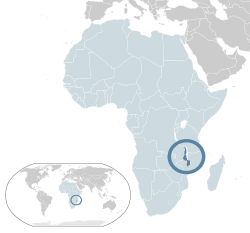
Malawi is a landlocked nation in southeast Africa. It was once known as Nyasaland, which probably means about as much to you as it does to me. Its closest neighbors are Zambia, Tanzania and Mozambique, and it's kind of hidden there in between them all. Malawi is one of the smallest countries in Africa, and is actually even smaller than it first appears since a whole third of it is occupied by a lake (also called Malawi).
There are a lot of undeveloped countries in Africa, and Malawi is one of the least developed of all of them--in fact, it is one of the least-developed countries in the world. It's economy is based on agriculture and there is an appallingly high rate of infant mortality there, plus a low life expectancy of around 50 years. HIV/AIDS is common, and a lot of people die from it, so many that the country currently has a half million AIDS orphans.
So that's depressing, and now let's talk about the cuisine. Because the country has an agricultural economy, there is a decent variety of foods grown there including sugar, coffee, corn and potatoes. Cattle and goats provide meat, and Lake Malawi is a source of fish. And the staple is that cornmeal thing I mentioned earlier, which is basically a stand-in for bread or rice and does a good job soaking up the juices of whatever is served with it. Yes, I did make some of that with my Malawian meal, so stay tuned to find out how we liked it (I bet you can guess!)
So Madagascar was OK. I think it really just suffered from the whole "not enough resources online" problem that a lot of African countries tend to have. I found a scattering of options but nothing that really sounded thrilling, and a lot of it actually sounded like stuff I've already made for other countries.
The main dish I chose, for example, was a coconut chicken. It sounded good because I like coconut chicken--I've had both Indian and Thai versions of it and I'm fairly sure I've done at least one coconut chicken for this blog in the past. I really did want to find something a little bit different, something that wasn't so familiar, but I did not have any luck. So if you are from Madagascar, you know, drop me a comment with your favorite recipe. I am very sure that out there somewhere is a Malagasy recipe that I will find really wowing. It just wasn't this one.
So here you go, all three recipes. Before you eagerly jump into making that dessert, which I'm sure you won't based on the hideous photo, make sure you scroll down all the way so you can read my notes. :)
Malagasy Coconut Chicken. A pretty basic chicken recipe made with coconut milk, garlic and ginger.
So there was nothing wrong with this recipe. It was good--flavorful and easy to make. It just wasn't that different--I've already tried a lot of recipes for chicken in a coconut milk sauce. Most of them have some additional feature besides just coconut milk, like a curry paste or garam masala. This recipe was really just coconut milk. There was some garlic and ginger as well, but other than that it was a little plain.
Malagasy Coconut Chicken
Now, I will say that it's really unfair to criticize international recipes for being plain. Sometimes they are plain just based on necessity--not every country has ready access to spices or even standard ingredients we in the west take for granted, like salt. So there's really nothing wrong with "plain." I would have settled for "different," though. But I can't really complain because as blog recipes go, this one was pretty fast and easy to make. Here's how:
Instead of roasting or pan frying your chicken, you boil it. You just put the whole chicken in a pot of boiling water and cook it until a meat thermometer inserted into the thickest part of the thigh reads 175 degrees (note: it's safe to eat at 165, but I find the texture of dark meat to be not quite right until it gets to 175).
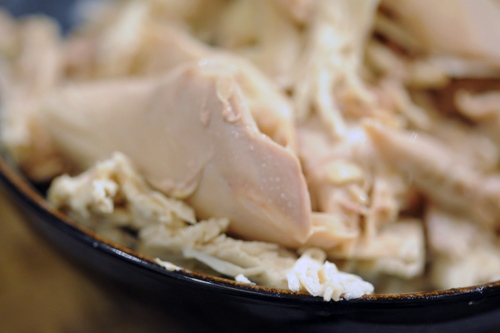
When the chicken is done cooking, knock the meat off the bones and set aside. Reserve 2 cups of broth.
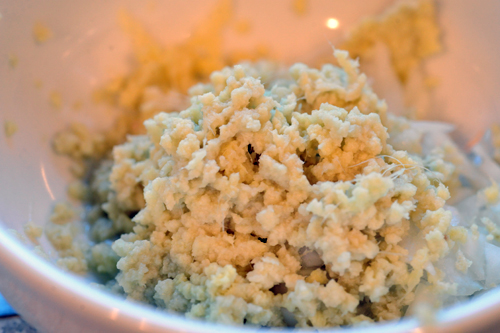
Now grate the ginger and garlic:
In a large frying pan (you'll need a large pan because in a minute you're going to be adding a whole chicken to it), heat the oil over a medium flame and add the onions. Cook until translucent, then add the ginger and garlic. Keep cooking until fragrant (one or two minutes). Add the chicken to the pan, along with 1 to 2 cups of the chicken broth and the coconut milk. Let simmer for 30 to 40 minutes (you can add a little extra broth if the sauce is too thick). Serve over rice.And here's the printable, pinnable version:
Fill up a big pot with water and add the whole chicken. Boil until a meat thermometer inserted in the thickest part of the thigh reads 175 degrees F.
Remove the meat from the bones and reserve the broth.
In a large frying pan, heat the oil over a medium flame and add the onions. Saute until the onions are translucent.
Add the garlic and ginger and keep stirring until fragrant.
Now add the chicken, 1 to 2 cups of the broth and the coconut milk. Simmer for between 30 and 40 minutes. You can add a little more broth if the sauce is too thick.
No matter how many times I've cooked dried beans, I never get used to the whole "you have to soak them first" thing. Or more accurately, I just never remember to do it.
Kabaro au Carry (Lima beans in tomato sauce)
Now, a few weeks ago I bought myself a new pressure cooker. You might remember that for a long time I was using my grandma's old pressure cooker, circa 1965, and there was that one time that it launched the little wobbly thing on top into the air like the space shuttle, which was mildly terrifying. And also those old pressure cookers sometimes explode, so yeah, it was time to get another one.
So anyway, when I bought my pressure cooker I was thinking, "Yay I don't have to soak beans anymore" (of course, it's not like I ever actually did soak beans ... but that's what I was thinking). But the cookbook that came with my pressure cooker was all, "You still have to soak the beans," and I was all, "What the what now?" So apparently buying the pressure cooker does not solve the whole bean soaking problem.
So I forgot to soak the beans, and then I tried to modify this recipe for the pressure cooker even though the beans were not pre-soaked, and although the whole thing wasn't a disaster or anything I'm not sure that the finished product was anywhere near what it would have been if I'd just followed the recipe.
So having said all that, here's the recipe, I'm going to tell you the proper way to do it and just pretend that that's how I did it.
So ideally, you want to rinse the beans and then soak them overnight. The next day, heat up the olive oil over a medium flame, then add the onion and cook until translucent.
Here's where I would normally add a picture, but I was too busy stressing out about the whole how-much-liquid-do-I-add-to-my-pressure-cooker-and-do-I-put-the-tomatoes-in-now-or-later thing and I forgot to take any.
Next, add the tomatoes and bring to a simmer. Cook for 10 minutes or so and then stir in the garlic and spices.
Drain the lima beans, and then add them to the pot with a fresh four cups of water. Bring to a boil, then reduce heat and simmer until the beans are tender (between 60 and 90 minutes). The sauce should be fairly thick, but add water if it gets a little clumpy.
Martin liked these more than I did. In the pressure cooker, the sauce cooked way down and I didn't actually think to add a little water to it, So it was almost like beans in straight tomato paste. Of course, Martin loves that really thick tomato flavor so he really liked them, but I found it overwhelming. Of course, I think it was my poor pressure cooker conversion that made the recipe turn out the way it did, so there's no way that can be a criticism. Anyway, here's the printable recipe:
Heat the olive oil over a medium flame, then add the onion and cook until translucent
Add the tomatoes and bring to a simmer. Let cook for 10 minutes or so, then stir in the garlic and spices.
Add the lima beans and water. Bring to a boil, then reduce heat and simmer until the beans are tender (between 60 and 90 minutes). The sauce should be fairly thick, but add water if it gets a little clumpy.
If it looks like an omelette, that's because it's an omelette
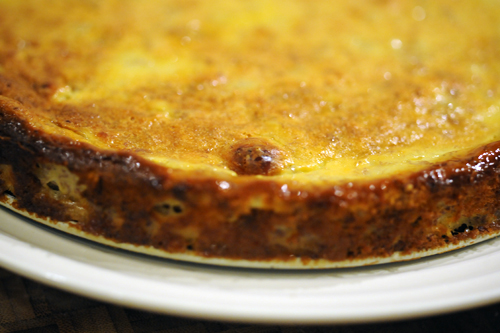
Now check out the photo of my cake, to the left. Same ingredients, same instructions. But WTF?? This dessert was so awful my kids didn't even want to eat it. And I'm sure it was because something went wrong with my interpretation, I'm sure it isn't supposed to look/taste like it looked/tasted when I made it.
Looking around, there are some recipes for Malagasy cakes that call for cassava flour, so I'm wondering if maybe whoever transcribed the recipe accidentally left it out. Or maybe I just needed to mix it more, with an electric mixer or something? Though I'm not sure how that would have solved the texture problem. Because it was a texture problem, not necessarily a flavor problem. It needed something to give it body.
Now, I've made flourless cakes before and they've been fabulous, and they had a lot of egg in them too. So I'm feeling like if it really wasn't supposed to have flour in it, then the instructions were leaving out a critical step or just assuming that I know something I obviously don't know.
Anyway, I can't imagine you would actually want to make this after that less-than-glowing recommendation, but just in case you do, here's how:
First cut a slit in your vanilla pod. The recipe didn't actually say to do this, but it's what I've seen Food Network chefs do--otherwise all the flavor just stays inside the pod.
Now put the pod in the milk with the sugar, nutmeg and clove. Bring just to a boil, then remove from the heat.
Add the tapioca and return to the stove over low heat. Cook 10 minutes, stirring frequently.
Meanwhile, heat your oven to 350 degrees and butter a round cake pan.
Remove the vanilla pod from the milk and add the cream and mashed bananas.
Now add the eggs one at a time. I guess. Mix well and pour into the cake pan. Bake for 15 minutes or until a toothpick inserted in the center comes out clean.
Now, it said cook for 15 minutes, but it took more like an hour in my oven, which is why I think that this recipe must have been missing an ingredient. If it had flour in it I think it would have baked up a lot more quickly, just like any cake.
Anyway, it was awful. Not the flavor, the flavor was actually fine, like a really sweet banana bread. But the texture was like scrambled eggs, so it really wasn't very pleasant. Again, I'm sure the fault was mine, unless an ingredient got left out of the recipe--which does seem a little likely.
Put the milk in a pot with the vanilla pod, sugar, nutmeg and clove. Bring just to a boil, then remove from heat.
Add the tapioca and then put back on the stove over a low flame. Cook for 10 minutes, stirring frequently.
Heat your oven to 350 degrees and butter a round cake pan.
Remove the vanilla pod and add the cream. Stir in the bananas.
Now add the eggs, one at a time, until everything is well mixed. Pour into the cake pan and bake for 15 minutes or until a toothpick inserted in the center comes out clean.
This week we're in ... San Diego. White sandy beaches, cleverly simulated natural environment ... complete with fake rocks. No! We're in Madagascar. And if your kids didn't watch that movie on loop for like six months straight, you have no idea what I'm talking about.
Madagascar, as it turns out, is not anything like San Diego. Madagascar is actually an island off the south eastern coast of Africa, and a big one too, the fourth largest in the world, behind Greenland, New Guinea and Borneo (wherever that is). If you've ever seen Madagascar (because everyone knows that kids' movies don't lie), you know that it's teeming with exotic animals like lemurs and fossa, the latter of which are in fact a real thing and I know because I was once shocked to see a bunch of them on exhibit at ... wait for it ... the San Diego Zoo. Fossa are kind of weird looking cat-dog-mongoose type things found nowhere else in the world, just like a stunning 90% of Malagasy wildlife. The reason for all this biodiversity has to do with the isolation of the island--it split from mainland India 88 million years ago, which gave native species a chance to evolve into really unique creatures.
Of course as interesting as this is, it doesn't have a whole lot to do with food ... unless you think we'll be eating a nice fossa stew with lemur ice cream for dessert. Malagasy cuisine is actually not as exotic as its wildlife is--most meals comprise of rice as a base served with an accompaniment that can be either meat or vegetables. Because hunting by early settlers basically wiped out the island's megafauna, most staple meat is pretty typical poultry and beef, which admittedly makes my job a lot easier.
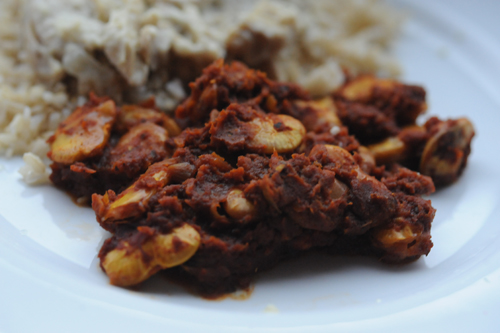
The standard Malagasy meal is called Vary sy laoka, which loosely translated means rice and whatever we happen to be serving with it today. I picked two dishes for my meal--a chicken and coconut laoka with some Lima beans cooked in a tomato sauce on the side. And there was a dessert, too, though honestly I'm really trying to block that out. :) Check back in a couple of days for the details.
These days, when you think about Liberia, you probably immediately think of ebola. Ever since the latest outbreak started no one seems to talk about Liberia for any other reason. In the past year, just over 3,600 Liberians have died from ebola, though the disease is happily in decline.
Even though the situation was (and still is, in many ways) tragic and terrifying, it is, of course, unfair to talk about Liberia as if ebola was the only thing that defines it. Liberia has, in fact, a really interesting history that you might not even be aware of. First, it's a colonial nation, and (shockingly) the colonists weren't British ... they were American. That's right, Liberia was founded by the US government in 1820 as a home for freed salves, presumably because it was a lot easier to send them there than to send them back to their homelands or, I don't know, give them rights and citizenship in the US. Of course I can't really pretend to understand the thinking behind that move, but it does seem to be at least partially motivated by goodwill. Evidently the American Colonization Society, whose idea this was, believed that blacks in the US would be a permanent racial underclass if they remained here, and would have more opportunity in Liberia. And while it's true that blacks in the US still have to put up with a lot of racist bullshit, I don't know that life in Liberia (even without ebola) is a whole lot better than even the worst poverty over here.
Now Liberian food--it's actually quite good if you don't eat bushmeat, which a lot of Liberians do. Many scientists and doctors actually suspect that that's where ebola comes from--in particular the fruit bat, which is both a Liberian food source and a known carrier of the disease.
So, I avoided fruit bat when I made my Liberian menu. Instead I chose these four recipes (all of them are from LiberianForum.com):
Chicken Gravy
1 to 3 lbs boneless chicken, cut up into chunks
1/3 cup cooking oil
2 tbsp flour
2 onions, sliced
2 Maggi cubes
3 tbsp tomato paste
Salt, pepper and cayenne pepper to taste
Dry Rice
1 cup rice, parboiled
1/2 lb salted pork
1 medium onion, chopped
2 quarts boiling water
1/4 tsp pepper (optional)
1 tsp salt, if desired
1 Maggi cube
1 tsp oil/margarine/butter
Rice Bread
2 cups cream of rice cereal
3 cups mashed bananas
1/2 cup vegetable oil
4 tbsp sugar
1/2 tsp nutmeg
1 tsp salt
1/2 cup water
1 tsp baking soda
Pineapple Nut Bread
2 1/2 cups all-purpose flour
1 tbsp baking powder
1 tsp baking soda
1 tsp salt
1 cup wheat bran
2 eggs, beaten
3/4 cup crushed pineapple, drained
1/2 cup chopped roasted peanuts or walnuts
First let's make the rice bread:
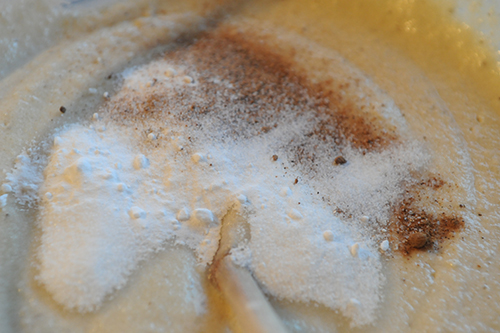
Preheat your oven to 400 degrees. Put all the ingredients in a large bowl and mix well.
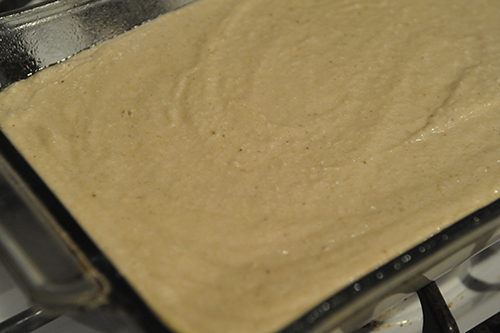
Pour into a greased 8 x 12 pan ...
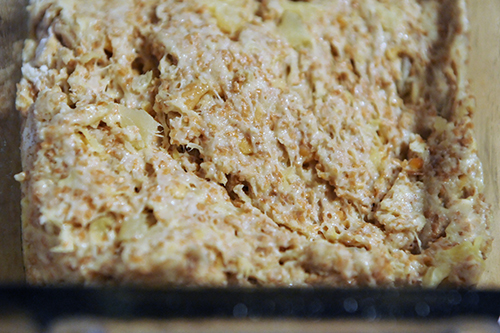
... and bake for 30 minutes, or until a toothpick inserted into the center comes out clean. That's it!
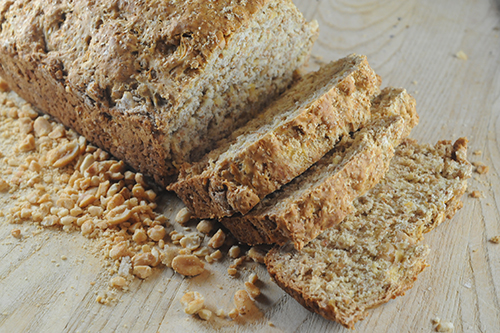
Now the pineapple bread:
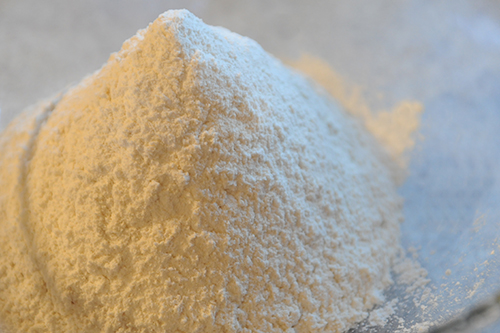
First sift the flour together with the baking powder, baking soda and salt.
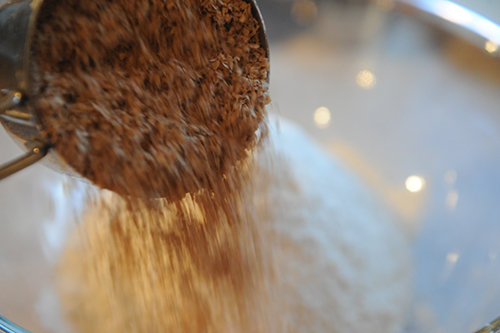
Now add the wheat bran, then mix in the eggs, pineapple and 1/4 cup of the nuts.
Mix well, then transfer the batter to a greased loaf pan. Mine was really stiff and had to be kind of molded into the pan.
Bake at 350 degrees for 1 hour, or until a toothpick inserted into the middle comes out clean. Top with the remaining nuts and serve.
Now for the chicken:
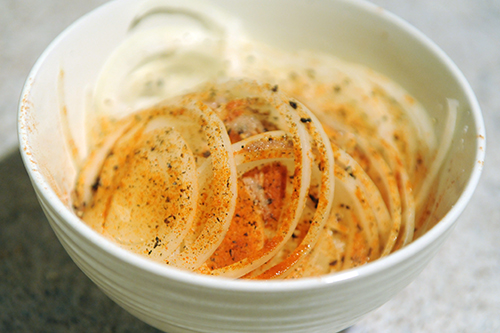
First mix the onions with the seasonings.
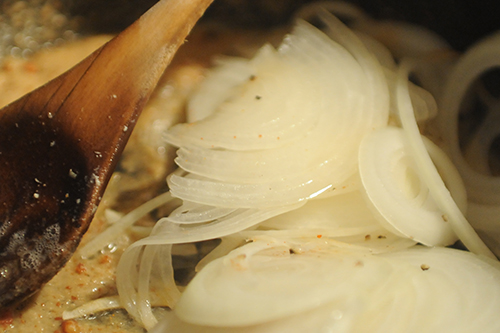
Then heat the oil and cook the chicken and onions until golden. Remove and set aside, reserving the cooking oil.
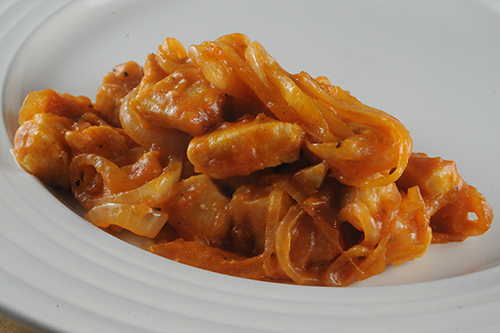
Add the peppers, Maggi cubs and tomato paste to the pot and fry for six minutes, stirring constantly. Now return the chicken to the pan and add a little water. Simmer until the chicken is cooked through and the sauce dries out a bit, then serve.
Finally, the rice:
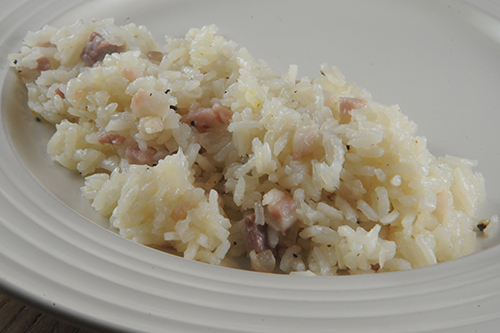
First rinse the rice in hot water and let drain. Now place the water, rice and oil in a pot. Bring to a boil.
Add the rest of the ingredients to the pot, then reduce heat to a simmer.
When the rice is al dente, remove from the heat and serve.
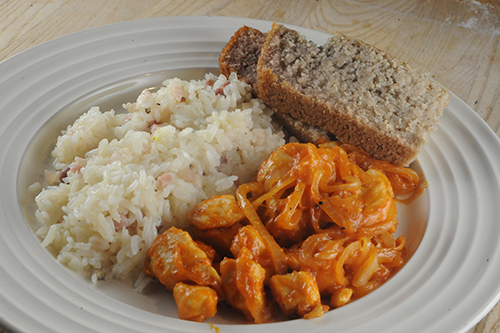
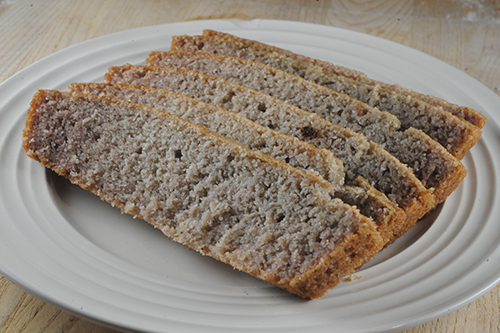
I really liked this. It was simple, which is pretty typical for African food, but I thought it had a lot of flavor. The rice bread I was actually a bit iffy about because it seemed more like a dessert or something you'd have with your coffee in the morning (all those bananas) and I really didn't like it served with everything else. It wouldn't surprise me to learn that it's really not the sort of thing you would serve with your chicken gravy and dry rice. The pineapple bread was pretty good too but I don't know, it kind of wanted to be a dessert and it kind of didn't. In the end I think I could have done without it.
I would actually make the chicken and rice again, though I'll probably stick with my own banana bread recipe. I do like simple recipes, and when they're simple and tasty, that's a win-win.