Some years ago I was invited to a friend's house for a Mexican meal, which was served with salsa on the side. I passed up the salsa because I tend to prefer unspicy Mexican food (to me, Mexican food is all about the cheese). When I said that fateful "no thank you," my friend then hit me with a snide "Oh, is it too spicy for you?" remark, which I guess I took badly. In defense of my honor, I invited her to dinner a few weeks later and served a Thai curry that was so spicy she couldn't even finish it.
Bratty, I know. But by telling you this story I'm admitting that the ability to eat and tolerate spicy food is kind of a badge of honor. Now before you get all defensive, yes it is true that many people (and I'm one of them) enjoy spicy foods for reasons other than machismo. But let's face it, there comes a point when the actual flavor of the food gets lost under all that heat, and it really is just about enduring the pain.
Which brings me to Bolivia. Now Bolivians, I am told, like it spicy. When I embarked on my Bolivian journey, I was thinking that probably meant hot Mexican-American salsa spicy, not London curry house spicy, which is several notches above the spiciest Mexican food you can get here in the US. So I was unconcerned.
Bolivia, as you probably know, is a South American nation. It is respectably large—in fact, at just over 424,000 square miles, Bolivia is the 28th largest nation in the world. It is also a high-altitude nation, with bragging rights to the world's highest elevation capital, La Paz, Bolivia, which is 11,942 feet above sea level. But wait, that's nowhere near the highest point in Bolivia—the highest point is the peak of Nevado Sajama, which is a whopping 21,463 feet above sea level (to put that into perspective, Mount Everest's peak is at 29,029).
With more than half its population living in poverty, Bolivia is not a rich nation, but it is culturally wealthy with traditions influenced by its native Quechua and Aymara populations as well as by Spanish colonialism. Likewise, its cuisine is a marrying of Spanish style with local ingredients.
Now despite the relative enormity of Bolivia and what I have no doubt is a rich culinary tradition, online resources for Bolivian food were scarce. I kept encountering the same small handful of recipes wherever I went, so I ended up choosing a meal based on sadly limited options. But the three recipes I did pick sounded pretty good, and here they are:
The appetizer: Pukacapas
(From Boliviansfood.com)
For the dough:
Next recipe: Fritanga
(From Boliviaweb.com)
Yes, that's right. A half cup of cayenne pepper. That is not a typo. Next recipe:
Arroz con Queso (Rice with Cheese)
(From BoliviaBella.com)
I started by making the filling and dough for the pukacapas, which I'm pretty sure I did wrong. Here's how it went:
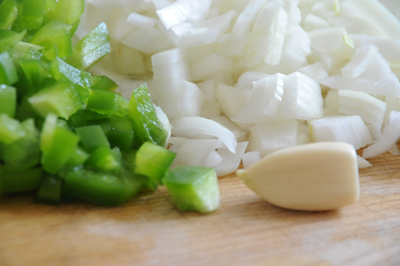
First mince and or chop all the ingredients.
Heat the oil in a medium saucepan and put everything except for the cheese into the hot oil. Saute for about 10 minutes, or until the vegetables are soft. Then take the pot off the heat and stir in the cheese.
Now as I mentioned above, I'm pretty sure now that you're supposed to use smaller, hot peppers and not bell peppers, though the bell peppers did taste good in this. Using bell peppers I ended up with way too much filling.
While the filling is cooking, make the dough. First blend all the dry ingredients with the butter, then add the milk and eggs. Blend until you get a smooth dough.
If you're making this ahead of time, you can shape the dough into a ball, cover it with plastic wrap and keep in the fridge until you're ready to use. Just let it warm up at room temperature for about 20 minutes before rolling it.
When you're ready to bake the pukacapas, preheat your oven to 350 degrees. Roll the dough out pretty thin (mine were a little too thick, which made the pastry-to-filling ratio too high). Cut into circular shapes. To assemble the pukacapas, drop some filling into the middle of one of the dough rounds, leaving enough space around the filling to join the two pieces of dough.
Cover the filling with another piece of dough, then moisten the edges a little with water and pinch together.
The original recipe did not say anything about cutting a slit in the top to vent steam, but you do need to do this (I didn't, and my pukacapas split open at the seam when baking). Just put a couple of little slits in the top like you would in a pie.
Now beat an egg and use it to brush the tops of each pastry. Bake at 350 degrees for 20 minutes or until golden.
Well before you put these in the oven, you should start on the fritanga, which needs to stew for a couple of hours.
First cut the pork meat up into bite sized pieces. If you have a fat-phobic husband (as I do), make sure you remove each infinitesimally tiny piece of fat from the meat, or he may use it as an excuse not to eat what you cooked.
OK yes I'm just the tiniest bit bitter about the fat thing. Because rib meat is, after all, a pretty fatty cut of pork, and I'm guessing that this recipe wouldn't have called for rib meat if the fat wasn't traditionally included in the dish. Now, I already knew that my husband is grossed out by fat, so I cut a lot of it off. So much, in fact, that I ended up with well under the 2.2 lbs of meat that this recipe called for. But I did leave some of it on because I didn't think I could do the recipe justice without it. Sigh.
Anyway, take your fat-free pork meat and put it in a pot with the cold water. Heat it to a boil and let it keep boiling until all the water is gone.
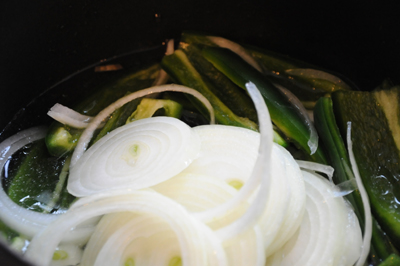
Now take the meat out of the pot and set it aside. Add the onions and a dash of salt and fry until translucent.
Then add the tomato, herbs and all the spices except for the cayenne pepper. Cook for two or three minutes until the tomato softens up a little. Now add the cayenne pepper. You'll get a really thick paste, which you should fry for another minute or two. Avoid the fumes or they might actually kill you.
Add the water or broth (I just used chicken broth), followed by the pork. Bring to a boil, then reduce heat and simmer for two hours, adding more stock as necessary to keep the amount of liquid in the pot at more or less the same level.
Five minutes before you are ready to serve, remove the pot from the heat and stir in the green onions.
Add the beaten eggs, stirring quickly to keep them from scrambling. They will thicken the stew. Now serve. If possible, put on some kind of body armor to prevent your family or guests from retributively murdering you.
Finally, let's do the rice. It only takes about 30 minutes, so start making it about an hour and a half into the fritanga.
First boil the water with the salt, then add the rice and keep boiling, uncovered, until almost all of the water has been absorbed or cooked off. The rice should still be pretty wet, but without pools of water and definitely not fluffy.
Meanwhile, sauté the garlic and onions in a small amount of oil for maybe four or five minutes. Take care not to let them brown.
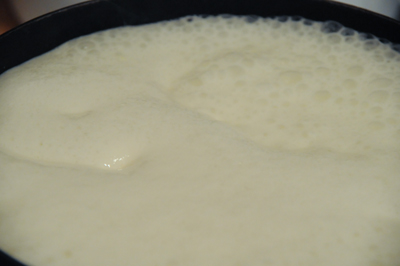
When the rice is nearly ready, bring the milk to a boil (warning, milk scalds easily so don't take your eyes off of it). Now add the milk, cheese and onion/garlic mixture to the rice. Cook over low heat, stirring, until all the cheese has melted.
So I already knew that this was going to be way too spicy for my children, because duh. So I made this meal just for me and Martin. Starting with the pukacapas:
They needed a few things.
First, more salt would have brought out the flavor a little. I attribute this more to the cheese substitution than anything: although most Bolivian resources seem to agree that queso fresco is a good American substitute for Bolivian cheese, I've read in at least one place that Bolivian cheese is saltier than queso fresco, which makes perfect sense since I've always thought queso fresco was really bland. So I should have used more salt in the filling.
Second, I didn't roll the dough thin enough, and the pastry (while good), overwhelmed the flavor of everything else.
Third, as I've already mentioned, I should have used jalapenos instead of bells.
They were still pretty good, but Martin and I both thought they could have been a little better.
OK now for the fritanga.
Martin took one bite and burst out coughing, then leapt from his chair and proceeded to have a dickie fit over an unopened package of paper towels, because as you know there's nothing like a good hot spicy meal to clear your sinuses. I took one bite and about fell out of my chair. It was hot.
Now, "hot" means a lot of different things to a lot of different people. In the US, people (on average) tend to have a lower threshold for spicy foods. So just to put this into perspective, up until now the hottest thing I've ever eaten was a chicken vindaloo in a London curry house. It's been probably a decade since I ate that vindaloo, but I'm about 95% sure that this was hotter, which means it's most likely the hottest thing I've ever eaten.
But I did eat it, because my ego wouldn't really let me do otherwise. I will say that I did not enjoy it. I have no idea what it tasted like. I do know that the pork was wonderfully tender, in fact I don't think it would have been any more tender if it had been sitting in a crockpot for eight hours. I just wish I could have tasted it.
After his initial coughing fit was over, Martin had a few more bites and then encountered a chunk of fat. Thinking it was a potato, he ate it and was then so disgusted he threw the rest of it away. Yes, my husband has a severe over reaction to fat. I should have known this. Of course, not wanting me to think that he'd woosed out over the heat, he then poured himself a meat-free bowl of fritanga sauce and ate it with a few of the leftover pukacapas and the rice. So we were both in pain, but with egos intact.
Oh yeah, the rice. I don't have any idea what it tasted like, either, because the normal function of my mouth wasn't restored until at least 30 minutes after the meal was over.
Now I won't say that Bolivian fritanga is too spicy for you or anyone else reading this blog, because you may be one of those rare people who can not only handle ridiculously spicy food, but actually likes it for reasons other than simply preserving your honor. But if you want to cut back on the cayenne pepper by say 80%, I won't tell anyone.
Next week: Bosnia and Herzegovina.
For printable versions of this week's recipes:
Bratty, I know. But by telling you this story I'm admitting that the ability to eat and tolerate spicy food is kind of a badge of honor. Now before you get all defensive, yes it is true that many people (and I'm one of them) enjoy spicy foods for reasons other than machismo. But let's face it, there comes a point when the actual flavor of the food gets lost under all that heat, and it really is just about enduring the pain.
Which brings me to Bolivia. Now Bolivians, I am told, like it spicy. When I embarked on my Bolivian journey, I was thinking that probably meant hot Mexican-American salsa spicy, not London curry house spicy, which is several notches above the spiciest Mexican food you can get here in the US. So I was unconcerned.
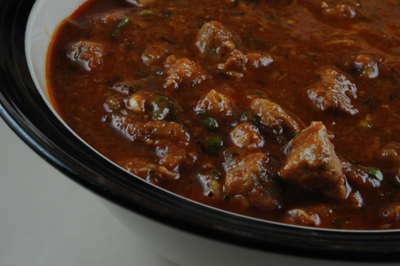 |
| The star of our show: Bolivian fritanga. |
Bolivia, as you probably know, is a South American nation. It is respectably large—in fact, at just over 424,000 square miles, Bolivia is the 28th largest nation in the world. It is also a high-altitude nation, with bragging rights to the world's highest elevation capital, La Paz, Bolivia, which is 11,942 feet above sea level. But wait, that's nowhere near the highest point in Bolivia—the highest point is the peak of Nevado Sajama, which is a whopping 21,463 feet above sea level (to put that into perspective, Mount Everest's peak is at 29,029).
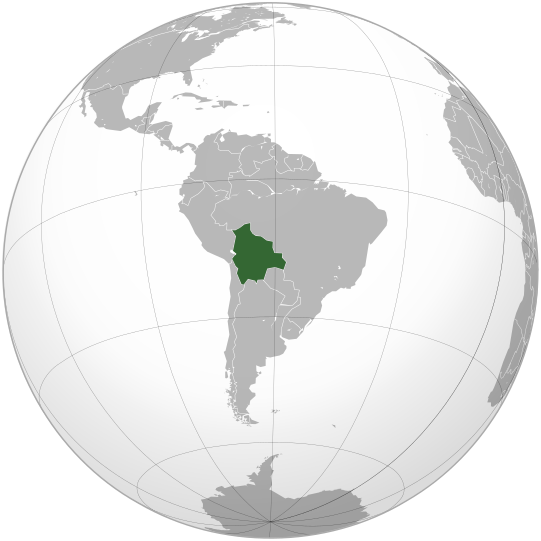 |
| Bolivia, the 28th largest country in the world. |
With more than half its population living in poverty, Bolivia is not a rich nation, but it is culturally wealthy with traditions influenced by its native Quechua and Aymara populations as well as by Spanish colonialism. Likewise, its cuisine is a marrying of Spanish style with local ingredients.
Now despite the relative enormity of Bolivia and what I have no doubt is a rich culinary tradition, online resources for Bolivian food were scarce. I kept encountering the same small handful of recipes wherever I went, so I ended up choosing a meal based on sadly limited options. But the three recipes I did pick sounded pretty good, and here they are:
The appetizer: Pukacapas
(From Boliviansfood.com)
For the dough:
- 3 cups flour
- 2 tsp Baking powder
- 3/4 tsp salt
- 1/3 cup butter
- 2 eggs
- 1/3 cup milk
- 1 egg, beaten (for brushing on top)
- 1 large onion, minced
- 1 small red pepper, minced*
- 1 small green pepper, minced*
- 1 tomato, minced
- 1 green onion
- 2 tbsp parsley, chopped
- 2 garlic cloves, minced
- 1/2 cup green olives, chopped
- 1/4 cup vegetable oil
- 3 cups queso fresco, crumbled
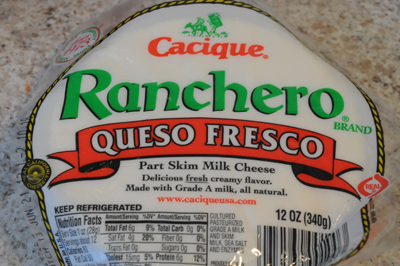 |
| This is queso fresco, available in most grocery stores. |
Next recipe: Fritanga
(From Boliviaweb.com)
- 2.2 pounds pork rib meat
- 2 cups cold water
- 2 cups white onion, thinly sliced
- 1 1/2 cup tomato, peeled and thinly sliced
- 1 tbsp mint, finely minced
- 1/2 cup parsley, finely minced
- 1 tsp fresh oregano, chopped
- 4 cloves garlic, minced
- 1 1/2 tsp ground cumin
- 1 tsp ground black pepper
- 1/2 cup ground cayenne pepper
- Salt to taste
- 4 cups water or broth
- 1 cup green onion, thinly sliced
- 4 eggs, beaten
Yes, that's right. A half cup of cayenne pepper. That is not a typo. Next recipe:
Arroz con Queso (Rice with Cheese)
(From BoliviaBella.com)
- 2 cups short grain rice (I used sushi rice, which seems to be the only short grain rice going around here)
- 1 1/2 cups crumbled queso fresco (kolla cheese is traditional, but most Bolivian resources seem to agree that queso fresco is a good substitute)
- 1 tsp garlic, minced
- 1 tbsp red onion, minced
- 1 cup milk
- 6 cups water
- Salt to taste
I started by making the filling and dough for the pukacapas, which I'm pretty sure I did wrong. Here's how it went:
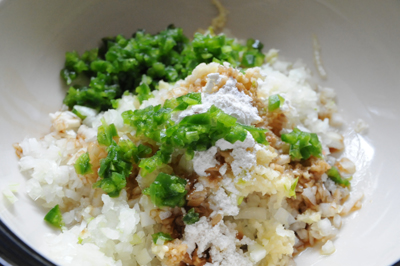
First mince and or chop all the ingredients.
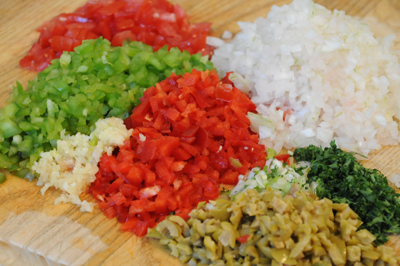 |
| These are the filling ingredients. Colorful, aren't they? |
Heat the oil in a medium saucepan and put everything except for the cheese into the hot oil. Saute for about 10 minutes, or until the vegetables are soft. Then take the pot off the heat and stir in the cheese.
 |
| Saute until the vegetables are soft, then take off the heat and add the cheese. |
Now as I mentioned above, I'm pretty sure now that you're supposed to use smaller, hot peppers and not bell peppers, though the bell peppers did taste good in this. Using bell peppers I ended up with way too much filling.
While the filling is cooking, make the dough. First blend all the dry ingredients with the butter, then add the milk and eggs. Blend until you get a smooth dough.
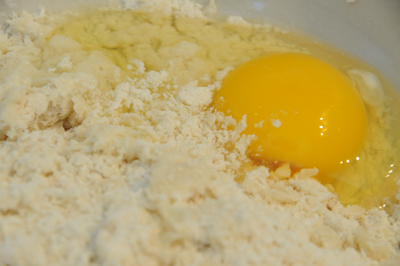 |
| Blend the dry ingredients, then add the milk and eggs. |
If you're making this ahead of time, you can shape the dough into a ball, cover it with plastic wrap and keep in the fridge until you're ready to use. Just let it warm up at room temperature for about 20 minutes before rolling it.
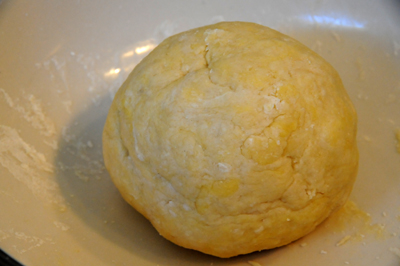 |
| Blend until you get a smooth dough. |
When you're ready to bake the pukacapas, preheat your oven to 350 degrees. Roll the dough out pretty thin (mine were a little too thick, which made the pastry-to-filling ratio too high). Cut into circular shapes. To assemble the pukacapas, drop some filling into the middle of one of the dough rounds, leaving enough space around the filling to join the two pieces of dough.
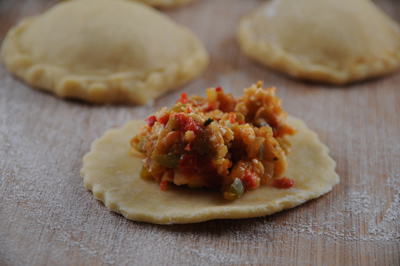 |
| Put a little bit of the filling into the center of the dough round. |
Cover the filling with another piece of dough, then moisten the edges a little with water and pinch together.
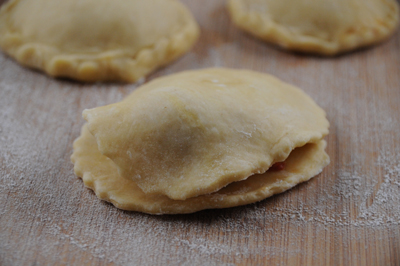 |
| Cover with another dough round. |
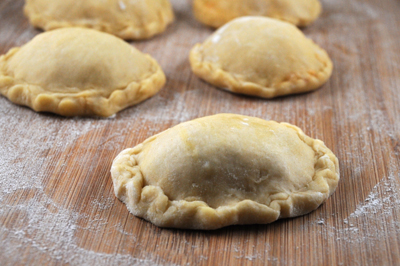 |
| Now crimp the edges. At this point I was having momo dumpling flashbacks. |
The original recipe did not say anything about cutting a slit in the top to vent steam, but you do need to do this (I didn't, and my pukacapas split open at the seam when baking). Just put a couple of little slits in the top like you would in a pie.
 |
| This is what happens if you don't cut slits in the tops of your pastries. |
Now beat an egg and use it to brush the tops of each pastry. Bake at 350 degrees for 20 minutes or until golden.
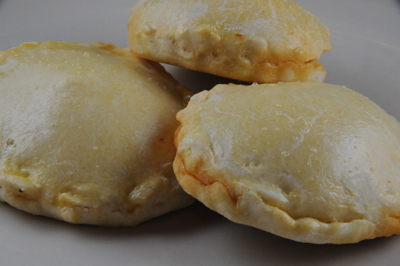 |
| From a certain angle they look pretty good don't they? |
Well before you put these in the oven, you should start on the fritanga, which needs to stew for a couple of hours.
First cut the pork meat up into bite sized pieces. If you have a fat-phobic husband (as I do), make sure you remove each infinitesimally tiny piece of fat from the meat, or he may use it as an excuse not to eat what you cooked.
OK yes I'm just the tiniest bit bitter about the fat thing. Because rib meat is, after all, a pretty fatty cut of pork, and I'm guessing that this recipe wouldn't have called for rib meat if the fat wasn't traditionally included in the dish. Now, I already knew that my husband is grossed out by fat, so I cut a lot of it off. So much, in fact, that I ended up with well under the 2.2 lbs of meat that this recipe called for. But I did leave some of it on because I didn't think I could do the recipe justice without it. Sigh.
Anyway, take your fat-free pork meat and put it in a pot with the cold water. Heat it to a boil and let it keep boiling until all the water is gone.
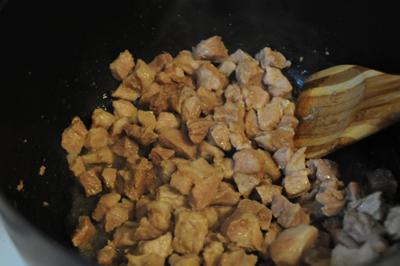 |
| Boil the pork in the water until the water has burned off. |
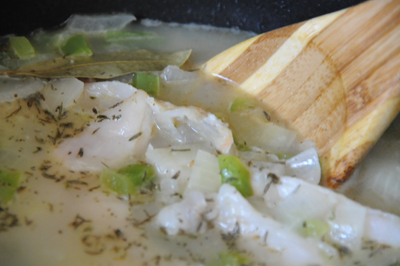
Now take the meat out of the pot and set it aside. Add the onions and a dash of salt and fry until translucent.
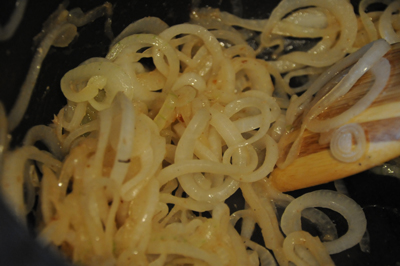 |
| Yes, frying onions. |
Then add the tomato, herbs and all the spices except for the cayenne pepper. Cook for two or three minutes until the tomato softens up a little. Now add the cayenne pepper. You'll get a really thick paste, which you should fry for another minute or two. Avoid the fumes or they might actually kill you.
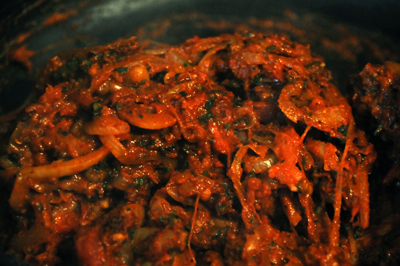 |
| If this photo fills you with fear, it should. |
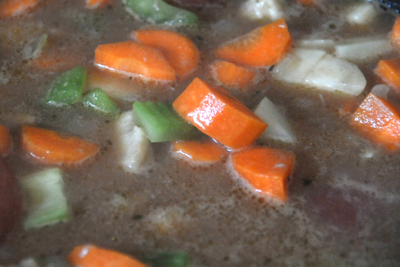
Add the water or broth (I just used chicken broth), followed by the pork. Bring to a boil, then reduce heat and simmer for two hours, adding more stock as necessary to keep the amount of liquid in the pot at more or less the same level.
Five minutes before you are ready to serve, remove the pot from the heat and stir in the green onions.
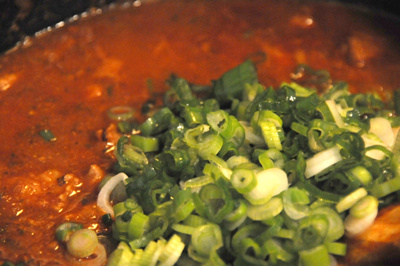 |
| Add the green onions ... |
Add the beaten eggs, stirring quickly to keep them from scrambling. They will thicken the stew. Now serve. If possible, put on some kind of body armor to prevent your family or guests from retributively murdering you.
|
| Look pretty innocent, doesn't it? |
Finally, let's do the rice. It only takes about 30 minutes, so start making it about an hour and a half into the fritanga.
First boil the water with the salt, then add the rice and keep boiling, uncovered, until almost all of the water has been absorbed or cooked off. The rice should still be pretty wet, but without pools of water and definitely not fluffy.
Meanwhile, sauté the garlic and onions in a small amount of oil for maybe four or five minutes. Take care not to let them brown.
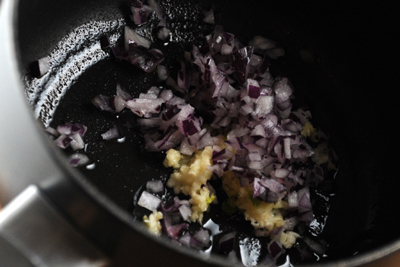 |
| More frying onions, but these are red! |
When the rice is nearly ready, bring the milk to a boil (warning, milk scalds easily so don't take your eyes off of it). Now add the milk, cheese and onion/garlic mixture to the rice. Cook over low heat, stirring, until all the cheese has melted.
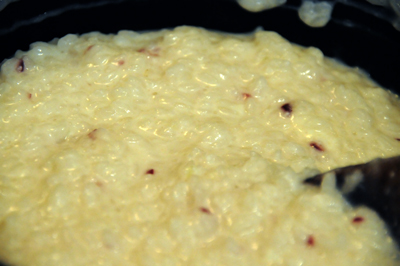 |
| After adding the milk and cheese. |
So I already knew that this was going to be way too spicy for my children, because duh. So I made this meal just for me and Martin. Starting with the pukacapas:
They needed a few things.
First, more salt would have brought out the flavor a little. I attribute this more to the cheese substitution than anything: although most Bolivian resources seem to agree that queso fresco is a good American substitute for Bolivian cheese, I've read in at least one place that Bolivian cheese is saltier than queso fresco, which makes perfect sense since I've always thought queso fresco was really bland. So I should have used more salt in the filling.
Second, I didn't roll the dough thin enough, and the pastry (while good), overwhelmed the flavor of everything else.
Third, as I've already mentioned, I should have used jalapenos instead of bells.
They were still pretty good, but Martin and I both thought they could have been a little better.
OK now for the fritanga.
Martin took one bite and burst out coughing, then leapt from his chair and proceeded to have a dickie fit over an unopened package of paper towels, because as you know there's nothing like a good hot spicy meal to clear your sinuses. I took one bite and about fell out of my chair. It was hot.
Now, "hot" means a lot of different things to a lot of different people. In the US, people (on average) tend to have a lower threshold for spicy foods. So just to put this into perspective, up until now the hottest thing I've ever eaten was a chicken vindaloo in a London curry house. It's been probably a decade since I ate that vindaloo, but I'm about 95% sure that this was hotter, which means it's most likely the hottest thing I've ever eaten.
But I did eat it, because my ego wouldn't really let me do otherwise. I will say that I did not enjoy it. I have no idea what it tasted like. I do know that the pork was wonderfully tender, in fact I don't think it would have been any more tender if it had been sitting in a crockpot for eight hours. I just wish I could have tasted it.
After his initial coughing fit was over, Martin had a few more bites and then encountered a chunk of fat. Thinking it was a potato, he ate it and was then so disgusted he threw the rest of it away. Yes, my husband has a severe over reaction to fat. I should have known this. Of course, not wanting me to think that he'd woosed out over the heat, he then poured himself a meat-free bowl of fritanga sauce and ate it with a few of the leftover pukacapas and the rice. So we were both in pain, but with egos intact.
Oh yeah, the rice. I don't have any idea what it tasted like, either, because the normal function of my mouth wasn't restored until at least 30 minutes after the meal was over.
Now I won't say that Bolivian fritanga is too spicy for you or anyone else reading this blog, because you may be one of those rare people who can not only handle ridiculously spicy food, but actually likes it for reasons other than simply preserving your honor. But if you want to cut back on the cayenne pepper by say 80%, I won't tell anyone.
Next week: Bosnia and Herzegovina.
For printable versions of this week's recipes:
- Pukacapas (Spicy Cheese Empanadas)
- Fritanga (Spicy Pork and Egg Stew)
- Arroz con Queso (Rice with Cheese)