Recipes from Marche, Italy

For this entry, I made two recipes. Neither of them were especially good, but I don't blame the people who posted the original recipes or any of the traditions they came from, I blame myself and my propensity for Googling things that might kill me.

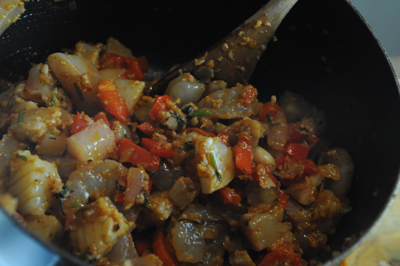
Recipes from Marche, Italy: Brodetto

A seafood stew with mussels and clams, minus the Vibrio.

Recipes from Marche, Italy: Filone Casereccio

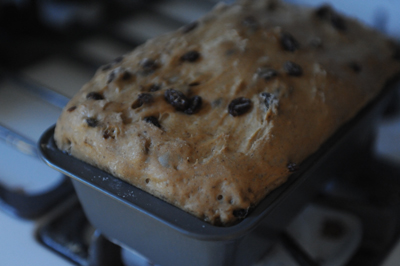
An Italian bread that will come out much better than mine did if you use fresh brewer's yeast and steam.

Recipes from Malta

This is actually the third time I’ve cooked a meal from Malta. The first time, I cooked the meal and then just did not write the blog post. Years went by.

Recipes from Malta: Imqarrun

Imquarrum (also called Imqarrun il-forn) is descended from a dish served in Sicily, but the Maltese have adopted it as a traditional staple. The key to making this dish is to be patient.

Thursday, March 21, 2013

Recipes from Egypt

I love Middle Eastern food, so I felt pretty at home this week. I have to say though, the main dish I ended up cooking turned out to be kind of a weird one.

I'm sure you already know something about Egypt, because everyone does. Land of the pyramids, pharaohs and Indiana Jones, you probably picture windswept dunes, camels and mummies whenever you think of it. At least I do, because I watch too much Discovery Channel.

Photo Credit: WanderingtheWorld (www.LostManProject.com) via Compfight cc

What you may not know is that with a population of 82 million, Egypt is not only one of the most populous nations in Africa, but also the 15th most populous country in the world. Most Egyptians live near the Nile River, since those windswept dunes of your imagination (or maybe just mine) make up most of the rest of its territory.


One of the reasons why we hear so much about Egypt is because it has been inhabited since 10,000 years BC, which as far as human history is concerned is a very, very long time. The people of Ancient Egypt were masters of architecture—that's why monuments such as the Sphinx and the pyramids at Giza are still standing, thousands of years after they were built. This makes it a mecca for archeologists as well as a source of great cultural interest and, of course, tourism.

So Egypt's culinary history is about as long and diverse as the rest of its history, which means that it was refreshingly easy to do the research for this meal. Traditionally, Egyptians have eaten a lot of vegetarian dishes—not for health reasons, of course, but because meat is very expensive for the majority of the population. I did not choose a vegetarian meal, though, because I found a chicken dish that seemed really interesting. Here it is:

Circassian-Style Chicken (Sherkasia)
(From Egypt Daily News)

For the chicken:
  • 6 lbs chicken leg quarters
  • 2 tsp olive oil
  • 2 small onions, sliced
  • 1 tbsp garlic, peeled and chopped with salt
  • Salt and freshly ground black pepper
  • Pinch of saffron
  • 4 cups water
  • 1/3 cup all-purpose flour
  • 1 tsp Near East or Aleppo pepper, or more to taste
  • Pinch of ground allspice
  • 2 1/4 cups shelled walnuts
  • 1 tbsp fresh lemon juice

For the red-tinted oil:
  • 1 tbsp walnut oil
  • 1/4 tsp Near East or Aleppo pepper
And on the side:

Couscous with Currants and Cumin
(From Tour Egypt)
  • 1 cup water
  • 1 cup couscous
  • 1/2 cup currants
  • 2 tsp olive oil
  • 1 small onion, finely chopped
  • 2 cloves garlic, finely chopped
  • 1 tbsp fresh ginger, finely grated
  • 1 tsp cumin seed, toasted
  • Zest of 1 orange
  • 1 tbsp fresh cilantro, finely chopped
  • Salt
  • Hot chili flakes
And some bread:

Eeish Baladi (Egyptian Bread)
(Also from Egypt Daily News)
  • 1 3/4 cups whole wheat flour
  • 3/4 cup + 2 tbsp water
  • 1/2 tsp salt
  • 2 1/2 tsp active dry yeast
OK, first the bread, which is very straightforward:

Dissolve the yeast in a little bit of the water and let stand until frothy. Meanwhile, mix the flour and salt together in a large bowl. Add the yeast mixture and and the rest of the water.

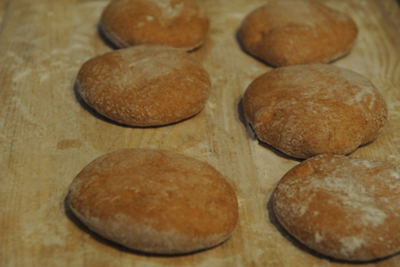
Knead until you get a smooth dough, then separate into six pieces. On a floured surface, roll the pieces into balls, then flatten with the palm of your hand. Let rise in a warm place until doubled (one to two hours).

Bake on a greased baking sheet at 350 degrees for 30 minutes or until brown.

Now for the chicken:

Eek! A spider! Oh, it's just saffron.

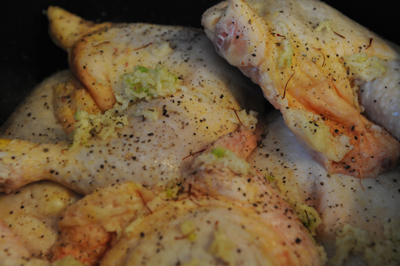
Heat the oil in a large pot and brown the chicken on both sides. Add 2 tsp of the garlic with the salt, pepper and saffron.

Pour the water over the chicken and bring to a boil, then reduce heat and simmer until the chicken is tender.

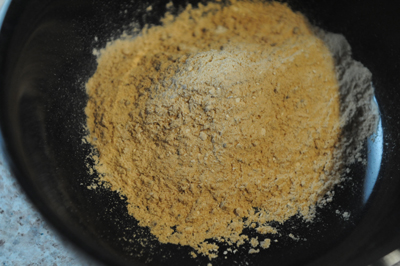
While the chicken is cooking, toast the flour in a dry pan over low heat until it turns a light brown color. Keep stirring so it doesn't burn. Add the pepper and allspice and stir for another 30 seconds, then remove from heat and set aside.

This is toasted flour.

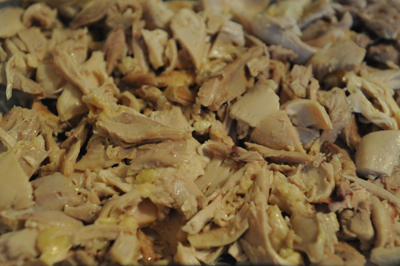
When the chicken has finished cooking, take it out of the pot (make sure to reserve the broth) and then remove the skin and bones. Now, here the recipe says to "cut into smaller serving pieces," which is next to impossible if you are, well, me. So instead of larger pieces I just had bite-sized chunks, because my meat fell apart as I was trying to remove the skin and bones.

Sprinkle some salt and pepper on the chicken and transfer it to a large bowl. Now strain the broth and skim the oil off the top (you should have about 3 1/2 cups of broth, I had a little more). Mix the rest of the garlic with 1 cup of broth and pour it over the chicken.

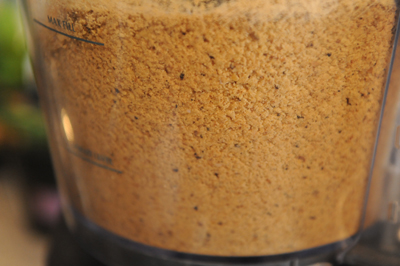
Now put the walnuts and seasoned, toasted flour into a food processor and pulse until you get very fine crumbs.

Add another cup of the chicken broth and keep processing until you the mixture becomes a smooth paste. Then add the rest of the broth, mixing to make a sauce with a creamy consistency.

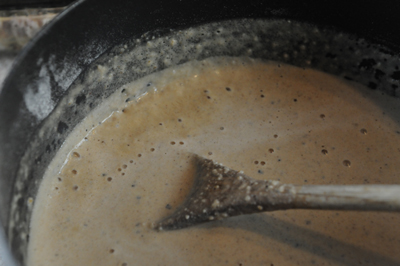
Transfer the sauce to the skillet where you cooked your chicken and bring to a boil. Reduce heat and simmer for 20 minutes or so, stirring occasionally to stop it sticking to the bottom of the pan.
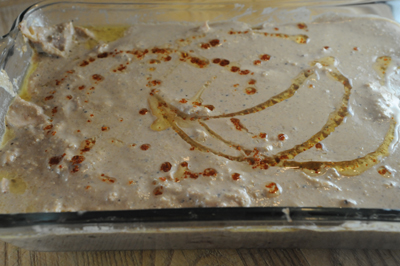
Pour the broth off the chicken pieces and then transfer them to a 9x13 casserole dish. Add a cup of the walnut sauce and the lemon juice and toss to combine.

Add a little bit of water to the walnut sauce to thin it out somewhat, then add salt to taste. Pour over the chicken.

Now, here's where the recipe said to put the whole thing in the fridge for two days. Since it was blog night (oh when will I learn to read these recipes in advance) I didn't have two days. But I will tell you that I did this with the leftovers and did not personally feel like it made a whole lot of difference to the flavor. So I don't think you need to do this, though it may not be as authentic to skip this step.

Make the red-tinted oil by heating the walnut oil in a small pan with the Near East pepper. You want the mixture to sizzle just a little bit, then remove it from the heat.

Meanwhile you'll be reheating your chicken, which may or may not have been sitting in your fridge for two days, in a 350 degree oven until warm, but not hot. Drizzle the oil over the finished dish and serve.

So yeah, a little weird. Now for the couscous:

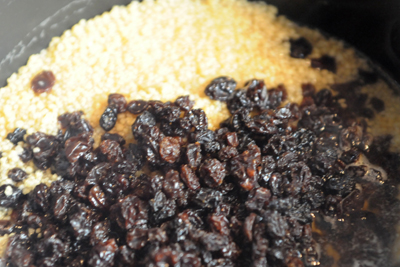
Boil the water and add the couscous and currants. Remove from heat and cover for 5 minutes.

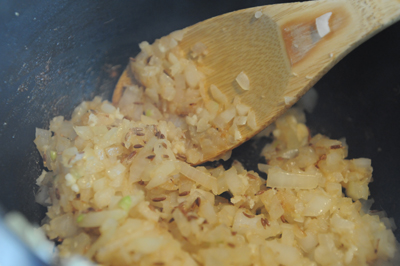
Meanwhile, saute the onion, garlic and ginger in the oil over a medium-high flame, until the onions are translucent. Add the cumin seeds and keep stirring for another minute.

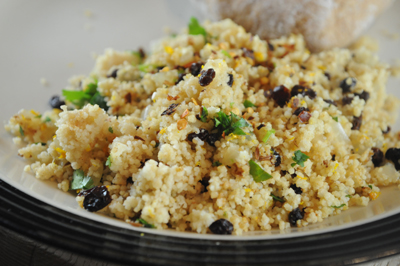
Remove the lid from the couscous and fluff with a fork. Add the onion mixture, the orange zest and the cilantro. Stir in a little salt and the hot pepper flakes to taste.

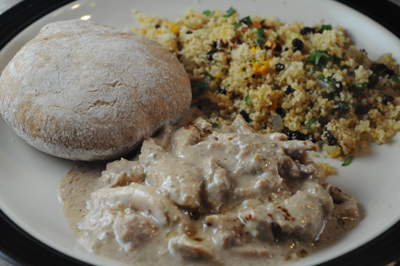
I really liked the chicken, but everyone else was pretty so-so about it. The flavor was pretty mild, though the garlic and lemon gave it extra points. I think Martin was expecting a more wowing culinary experience, so he wasn't terribly excited by it. Plus he doesn't particularly like dark meat, which I don't personally understand because I think dark meat has loads more flavor than white. But anyway …

The bread was boring. No way around it. It could have used some more salt to make it less bland, but I'm not sure huge flavor is really its purpose. If Egyptian bread has the same roots as Indian nan, it's just meant to mop up sauce and therefore doesn't need a whole lot of flavor of its own (actually, nan has a ton more flavor, but there you go). My kids liked it though. Of course, they slathered it in butter which is probably not terribly traditional, though I guess I can't say for sure.

The couscous was pretty good—Martin's favorite part of the meal. Personally I thought it tasted a little bitter, which is probably due to overzealous zesting (my fault). I do like couscous with fruit of any kind, so cooking this again another time may be in my future.

There's Egypt, then. I think I expected more, but that's probably because that whole romantic Egyptian ancient history thing made me expect food that reflected some of that romance. Oh well, every culinary experience can't be worthy of the Discover Channel, I guess.

Next week: El Salvador

For printable versions of this week's recipes:

Thursday, March 14, 2013

Recipes from Ecuador

Traditional food isn't always delicious to us Westerners. That's because people living in poorer nations often just don't have the resources you need to dress up a meal, such as spices, herbs or even just ordinary table salt. For these people, something as basic as meat, onions and rice make a delicious meal because a delicious meal is really anything that fills up your belly.

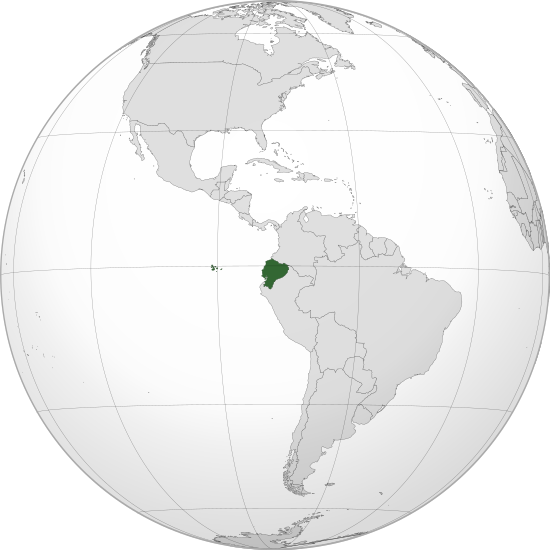
Then there's Ecuador. Now, you can't really say that Ecuador is a particularly wealthy nation (in terms of GDP the US ranks 8th while Ecuador is all the way down at 91). But it is a growing nation: the 8th largest economy in Latin America with a growth rate of 7.8% in 2012. Extreme poverty in Ecuador has declined by leaps and bounds since the turn of the century; in 2001 it was a whopping 40% and now it is down to 17.4%.

The nation of Ecuador includes the Galápagos Islands, made famous of course by Charles Darwin, and is one of 17 "megadiverse countries"—those countries that harbor the majority of the Earth's species—as identified by Conservation International in 1998.

Quito, Pichincha, Ecuador. Photo Credit: shapeshift via Compfight cc

So this also means that Ecuadorians have access to lots of yummy ingredients, partly because the terrain, altitude and agriculture varies greatly from one part of the country to the next.  Seafood, for example, is predictably popular on the coast, while meat and potatoes is preferred in the mountains and tropical fare such as cassava and bananas is commonly eaten in the rainforest.

So when researching Ecuador I landed almost immediately on one blog and then did not go any farther than that. Because every single thing on this blog looked super awesomely yummy. In fact, I downloaded far more recipes than I could use for this one entry, and I plan to make all of them offline at some point or another.

Here's the blog, since she deserves pretty much all the credit for this entry:

Laylita's Recipes (Note: I had to take remove the link because of a malware warning)

All you have to do is land on her homepage and I promise you'll get sucked in by all the amazing pictures of colorful and delicious looking recipes. If you have any kind of fondness for Latin American food, you will love this website.

So anyway, I chose about a million recipes and then somehow managed to narrow it down to these six (six!):

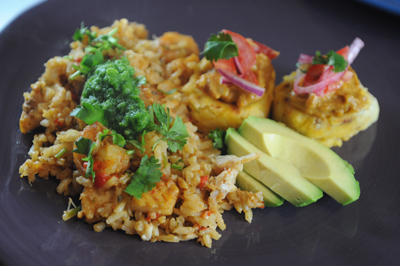
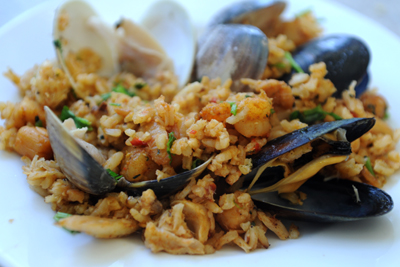
Arroz Marinero

This is very similar to a Spanish paella, only with different spices. Here are the ingredients:
  • 2 tbsp oil
  • 2 tbsp white onion, finely chopped
  • 1 garlic clove, minced or pressed
  • 2 cups long grain rice
  • 2  1/4 cups seafood stock
  • 3 tbsp sunflower, peanut or light olive oil
  • 1 1/2 cup white onion, finely chopped
  • 2 heads garlic, peeled and crushed
  • 1 red bell pepper, diced
  • 1 1/2 tsp cumin
  • 1 tsp achiote powder
  • 1 bunch of cilantro, finely chopped
  • 4 lbs seafood: shrimp, calamari, scallops, mussels, clams, crab or whitefish*
  • Salt and pepper to taste
* Based on what I can tell from this and other versions of this recipe, arroz marinero is generally made with a mixture of different seafood, which may include some or all of what I've listed above. I think you can be flexible on what you decide to use, though every recipe I saw included the mussels, clams, calamari and shrimp with some variation of everything else.

The arroz marinero is served with these two garnishes/sauces:

Aji Criollo
  • 4 hot peppers (I used jalapenos, but you could use serranos if you wanted it spicier)
  • 1/2 bunch cilantro
  • 1/2 cup water
  • 3 garlic cloves
  • Juice from 1/2 lime (or lemon)
  • 3 tbs finely chopped white or green onion
  • Salt to taste

Curtido de Cebolla y Tomate
  • 2 small red onions, thinly sliced
  • Juice of 3 limes
  • 1 tbsp sunflower or canola oil
  • 3 tomatoes, thinly sliced
  • 1 tbsp cilantro, finely chopped
  • 1 tbsp salt (more to taste)
The curtido also goes with this recipe:

Llapingachos
  • 5 large Russet potatoes, peeled and cut into large pieces
  • 2 tbsp sunflower oil
  • 1/2 cup white onion, finely chopped
  • 2 tsp ground achiote
  • 1 cup grated Mozzarella or Fontina cheese
  • Salt to taste
And you also really, really need this to put on top of the llapingachos:

Salsa de Mani
  • 3/4 cup unsweetened peanut butter
  • 1 cup milk
  • 1/2 cup white onion, finely diced
  • 1 tsp cumin
  • 1 tsp ground achiote
  • 2 tbsp peanut oil or butter
  • 1 tbsp cilantro, finely chopped
  • 3 tbsp white onions, finely minced or sliced
  • 1 hard-boiled egg, finely chopped (optional)
  • Salt to taste
And in case you aren't already exhausted, here's the dessert:

Raspberry, Goat Cheese and Almond Empanadas
  • 3 cups all purpose flour
  • 1/4 to 1/2 cup sugar (depending on how sweet you like it)
  • Pinch of salt
  • 2 sticks butter, cut into 16 pieces
  • 2 eggs
  • 2 to 4 tbsp cold water
  • 12 oz raspberries
  • 11 oz plain goat cheese, room temperature
  • 1/2 cup sugar
  • 1 tsp vanilla
  • 1 tbs orange zest
  • 1/2 cup sliced almonds
  • 1 egg, separated
  • 1/4 cup demerara sugar

OK, yes, three of these recipes are sauces. Delicious, super-yummy sauces.

Anyway, I started with the dessert, as I often do, since it can almost always be made ahead. Here's how it's done:

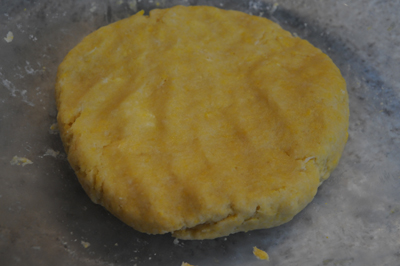
First mix the dry ingredients together, then add the butter and eggs, gradually adding the water until you get a nice smooth dough. Divide the dough into two balls and flatten with the palm of your hand, then put them in the fridge for a half hour or so.

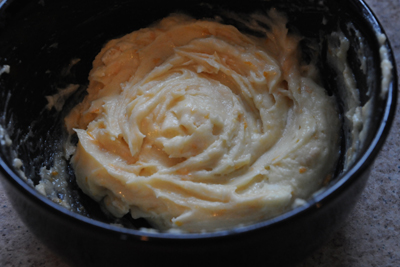
Meanwhile, mix the goat cheese with the sugar, vanilla and orange zest.

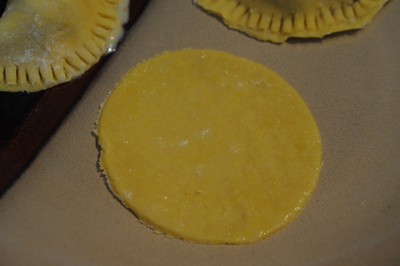
After the dough has chilled, transfer it to a floured surface and roll out to maybe 1/8 inch thick. Cut the dough up into small disks (I thought my biscuit cutter was a bit too small so I used a glass). Stop eating the dough or you won't have enough to make the empanadas. Whisk the egg white and yolk lightly in two separate bowls.
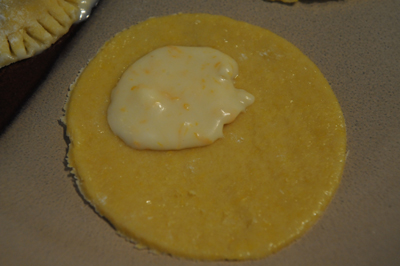
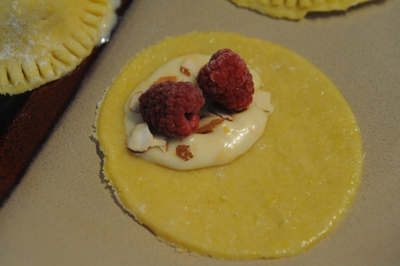
Now place a teaspoon or two (depending on the size of your disks) of the goat cheese mixture sort of off-center on each disk.

Sprinkle with the sliced almonds and add two raspberries.

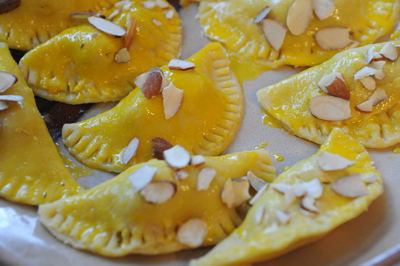
Paint the edges of the disk with the egg white and then fold the dough over, pinching to seal. Press down with a fork along the edges and then cut three tiny slits in the top to (theoretically) help stop your empanadas from exploding in the oven. Now brush with the egg yolk and then sprinkle with some more almonds and the demerara sugar.

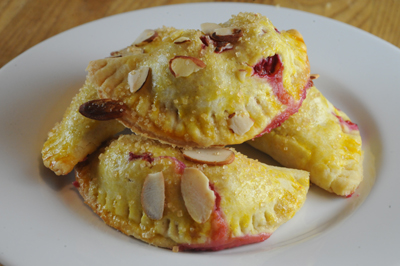
Return the empanadas to the fridge for another 30 minutes, then transfer to a preheated oven and bake at 375 degrees for 20 to 25 minutes or until they turn a nice golden brown color.

Now let's do the sauces, since they can be made ahead too.

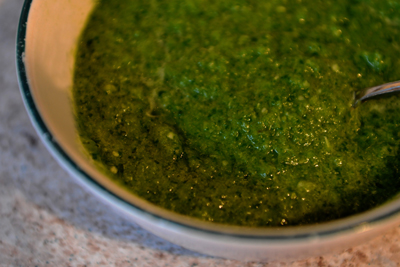
To make the aji criollo, just put everything except the chopped white onions and salt in a blender or food processor and blend until you get a smooth sauce. Now add the onions and salt. Done!


Now for the curtido:

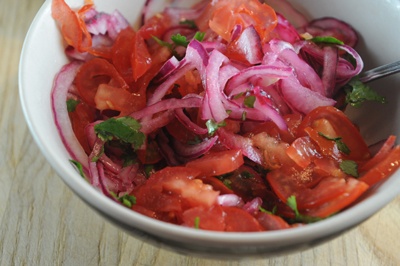
First sprinkle the onions with 1 tbsp salt and set aside for 10 minutes or so. I think this helps draw out some of the liquid in the onion, which I'm guessing makes them crispier though that is a hugely uneducated guess. Now pour lukewarm water over the onions and let sit for 10 additional minutes. Rinse and drain.

Put the onions in a bowl with the lime juice and oil and refrigerate for 30 minutes. Just before you are ready to serve, take them out of the fridge and add the tomatoes and the cilantro. Adjust the salt to taste and serve.

Finally, the salsa de mani:

Mix the peanut butter with half of the milk and stir until dissolved.

Melt the butter/oil over medium heat and then add the onion, achiote, cumin and salt. Keep stirring until the onions are translucent.

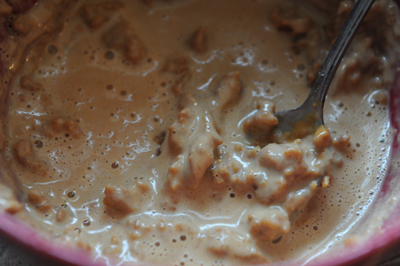
Add the peanut butter/milk mixture and the rest of the milk. Bring just to a boil, reduce heat and simmer for 10 minutes, stirring frequently. Remove from heat, then add the boiled egg, cilantro and onions. (Note: you may need to add a little more milk to thin the sauce).

Since the potato dough for the llapingachos has to sit at room temperature for a while, I'm going to have you do that next.

First boil and drain the potatoes. Now you need to heat the oil over a medium to high flame and add the onions and achiote. Cook until the onions are translucent.

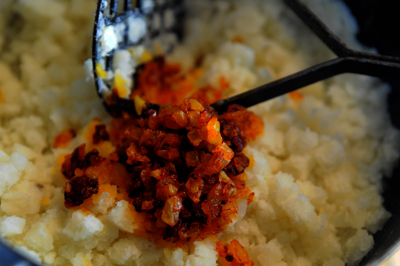
Mash the potatoes (don't add any milk or butter, just mash them) and then add the onion/achiote mixture. Add salt to taste, then let the mixture set at room temperature for one hour.

Roll the potato dough into balls about the size of golf balls. Make a hole in each one with your finger (they will fall apart a bit when you do this, so its best to cup them in your hand and then press them back into shape as necessary) and then stuff the grated cheese into each hole. Close up the holes and gently press each ball into a flat patty. Put in the fridge for another half hour to hour.

Now cook each patty on a dry, nonstick frying pan. If you use oil these things will fall apart, so just cook them right on the nonstick surface. And don't be tempted to press down on them or they will crumble. You need to make sure they are the right shape before they go in the pan. When brown on one side, turn them over gently and brown the other side.

Top with the salsa de mani and onion curtido.

OK, if you haven't already dropped dead I just have one more thing for you to do—the main course. Here goes:

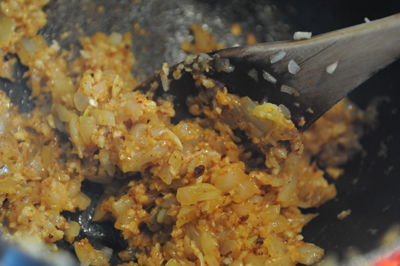
Heat the first measure of oil over a medium flame and add the onion and garlic. Keep stirring until the onion is translucent.

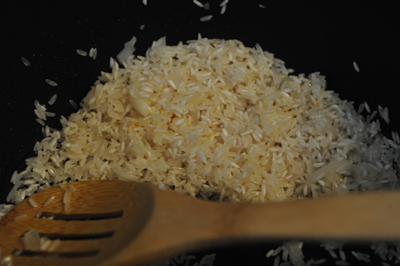
Now add the rice and stir. You want every grain of rice to be covered with oil.

Next add the broth and bring to a boil. Continue to boil until the broth is absorbed, then reduce the heat as low as it will go. Cover the pot and let simmer for 15 minutes, or until the rice is al-dente.

Now heat that second measure of oil and add the rest of the chopped onions and the two whole heads of crushed garlic. Cook until the onions are translucent. Now add the spices, half of the cilantro and the bell pepper. Cook for five more minutes, stirring often.

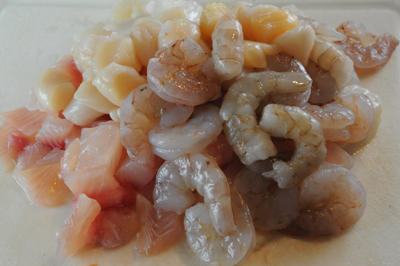
Here's where you add the seafood. Start with the stuff that will take longer to cook, such as the white fish, the shellfish and large shrimp.

Gradually add the rest of the seafood and stir for three or four minutes.  Transfer the rice to the pot and mix well. Keep stirring until everything is cooked through.

Add the rest of the cilantro and salt and pepper to taste.

OK so I'm sure you're wondering if it was all worth it. And yes, yes it was. This meal was truly as delicious as it looked like it was going to be, and though my back ached for three days after all that time in the kitchen it was more than worth all the effort.

The arroz marinero was excellent and probably came out better than any paella I've ever made. The rice was really light and fluffy (which is because of the cooking technique of boiling off the stock and then simmering) and the spices made the dish different enough that I didn't actually feel like I was eating some variation of a paella. Martin enjoyed this dish too which is saying something since he doesn't tend to love seafood, though he'll usually eat it without too much complaint. I really enjoyed the aji criollo on top of this dish, which was really spicy and made for a delicious twist on seafood, which I don't often eat with a spicy accompaniment.

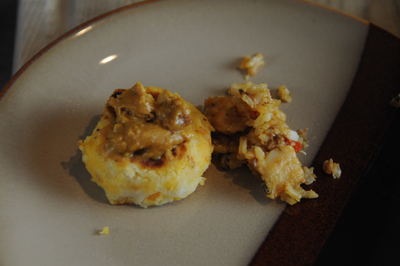
The llapingachos, well, what can I say about them. I've never had so much success with a mashed-fried-patty anything, and I think Laylita was seriously on to something when she hit on frying these in a dry pan. Next time I try making one of those infamous bean patty things which seem to be so popular in Caribbean nations, I'm going to do it this way to see if I can get an actual patty instead of a pile of greasy mush. But beyond that, the llapingachos were also really tasty. I could have put more cheese in them because as they were they really just barely tasted of cheese, which is a crime against cheese. But topped with the salsa de mani and the curtido they were still irresistible. I wish I'd made more of them. Tons more.

And just for a laugh, here's what my kids' plates looked like:


 And yes, they looked pretty much exactly the same at the end of the meal, too.

As for the goat cheese empanadas—well, I once loved goat cheese but let me just say that norovirus and goat cheese aren't really a good combination (and I'll leave it at that). Ever since that experience I've kind of not really liked goat cheese anymore, but in this recipe it was pretty good. I think I would have preferred to make these empanadas with cream cheese but that is wholly because of my own negative experiences. Goat cheese lovers will love this recipe, I promise. Even my kids loved it. Hailey was shocked to learn she'd just eaten goat cheese and still wanted more. And that is really saying a lot.

So if I had to pick a country in South America to visit, I think Ecuador would be right up there at the top of my list, though I doubt I would do much more than eat the whole time I was there. Well, maybe I would visit the beach while eating. Or eat as I explored Galápagos. You get the idea.

Next week: Egypt

For printable versions of this week's recipes:

Thursday, March 7, 2013

Recipes from Eastern Canada

Someone laughed at me this week when I said I was dividing Canada up into regions. Maybe it is a tad silly, I mean, it's not like Canada is known for its cuisine or anything. I've seen French restaurants, Indian restaurants and Chinese restaurants, but I don't think I've ever seen a Canadian one. Though I did once go to an "American" restaurant in the UK. All the waiters wore cowboy hats and I think there was sawdust on the floor.

Anyway, Canada is a big country and it is actually pretty diverse, so I still stand by my decision to divide it into regions. And in fact this week's meal was considerably different from the meal I did for Central Canada, so that is yet more evidence that it was the right thing to do.

The Battery, St John's, Newfoundland. Photo credit: manumilou via Compfight cc
Depending on who you ask, Eastern Canada is either everything east of Manitoba, or it's just the eastern coastal provinces. Now, when I did Central Canada I included Quebec and Ontario in that region, so for the purposes of this post I focused on Newfoundland, Labrador, New Brunswick and Nova Scotia (also called Atlantic Canada). And then as I was narrowing it down to just the three recipes I ended up serving, I was down to just Newfoundland.


It probably won't surprise you to hear that a lot of the cuisine from this part of Canada is seafood-based. The seafood industry in Newfoundland and Labrador alone is a $1 billion industry employing more than 20,000 people. Cod was once the most important fish harvested in this area, until overfishing drove the Canadian government to place a moratorium on it in the early 90s. Today, snow crab and shrimp have replaced cod as the region's most important harvested species. Aquaculture is also an important part of the industry: atlantic salmon, steelhead trout, and blue mussels are all farmed in Newfoundland.

So yes, I chose a seafood recipe. I wanted something that was pretty traditional, so I searched until I found this recipe on a website called Newfoundland Island Recipes:

Salmon Pie
  • 8 oz cooked salmon, flaked
  • 1/2 cup butter, divided
  • 2 lbs potatoes (use an extra pound if you want your topping to be thick)
  • 1/4 cup warm milk
  • 1 egg, unbeaten
  • 1 1/2 cups reserved potato water
  • 2 onions
  • 3 tbsp flour
Martin likes to eat his pies with baked beans, so I thought it would be fun to make some baked beans from scratch—having only ever eaten them out of a can. Wow that sounds so embarrassing when I say it out loud.

Here's the Newfoundlander's version of Old Fashioned Baked Beans:
(from Newfoundland.ws)
  • 2 lbs dried white navy beans
  • 1 medium onion, sliced
  • 1/4 cup ketchup
  • 1 tsp yellow mustard
  • 1/4 cup brown sugar
  • 3/4  lbs salt pork, sliced
  • 1/2 cup molasses
And I also chose a sweet bread for dessert, although this would have been fine served with the meal, or even for breakfast and/or with a cup of coffee:

Lassy Bread
(also from Newfoundland.ws)
  • 1 tsp sugar
  • 1/2 cup lukewarm water
  • 2 1/4 tsp active dry yeast
  • 2 1/2 cups milk or water
  • 1/4 cup butter
  • 1 tbsp salt
  • 1/2 cup molasses
  • 6-7 cups flour (all-purpose)
  • 2 tsp cinnamon
  • 1 tsp mace
  • 1 tsp cloves
  • 4 cups raisins
Starting with the beans:

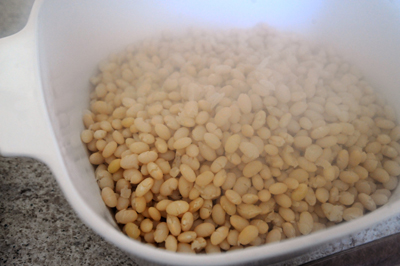
I feel like I should put this is all caps and hot pink text or something, because I'm always forgetting to soak beans. So the day before you make this meal, SOAK YOUR BEANS. Amazingly, I did remember to do it this time.

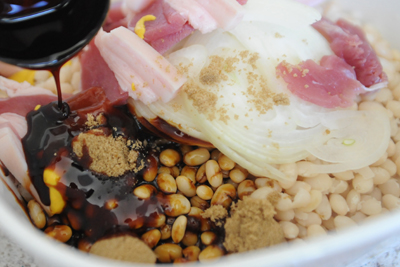
The next morning, rinse the beans then put them in a pot with water. The water level should be about two inches above the top of the beans. Now boil for about 30 minutes, or until the beans are tender.

Preheat your oven to 250 degrees. Transfer the beans to a casserole dish and mix in the rest of the ingredients. (Note: you can get salted pork at Safeway! It comes packaged and can be found with the sausages or with the bacon, depending on your store).

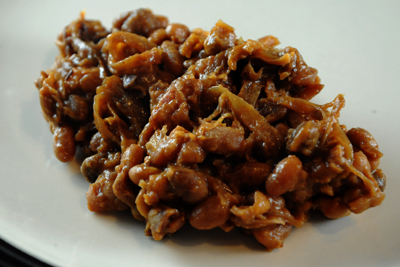
Cover and bake for 6 hours, then remove about 1 cup of the beans and mash them with a potato masher. Mix them back in and return to the oven for another hour, this time uncovered.

Now if your husband has also never eaten baked beans that did not come out of a can, he might be horrified to discover (as mine was) that old fashioned homemade baked beans are quite a bit drier than what he is used to. This actually may be the first time in my life that I've made something from scratch, only to be told that I need to do a better job emulating the stuff that comes out of a can. So if your family (or you) like a saucier bean, I don't think it's too off the recipe to mix a little water in with the beans towards the end of the baking cycle.

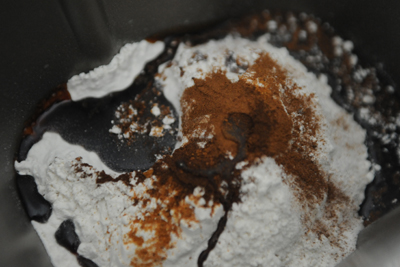
So meanwhile, make the bread. Now you already know I do everything in my bread machine, even bread recipes that aren't really intended for a bread machine. But if you want to do it the traditional way:

Add the sugar to the water and then use that mixture to dissolve the yeast. Let stand until frothy (10 to 15 minutes). Meanwhile, put the butter and milk in a small pan and heat until the butter melts. Remove from the stove and let cool to lukewarm.

Meanwhile, mix the molasses with the yeast mixture, half of the flour, spices and raisins. Mix well. Add the rest of the flour bit by bit until you get a soft dough. Knead for 10 minutes or until the dough is smooth and elastic.

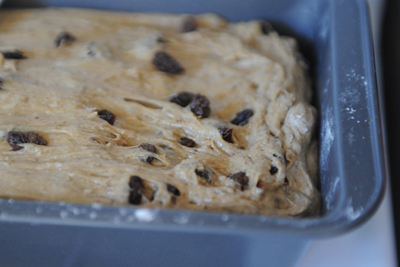
Put the dough in a lightly oiled bowl and let stand in a warm place until it is about doubled in size. Now divide the dough in half and transfer to two greased 9x5 loaf pans.

Cover with a clean, damp tea towel and let rise again for 1 to 2 hours, or until it doubles again.

Bake in a 370 degree oven for 1 hour. The bread should be golden and should make a hollow sound when you knock on it. Remove from the oven and brush with a little melted butter.

Finally, you can get started on the fish pie. It helps if you have two ovens, because the baking temperatures are quite a bit different between the beans and the pie, and the beans have to be cooked for a long time. Don't have two ovens? You'll probably need to finish the beans an hour before the pie, and then reheat.

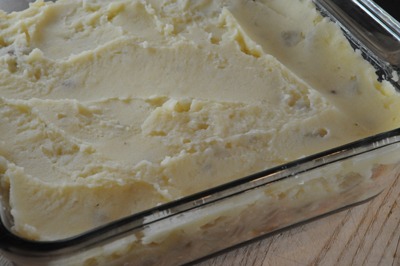
So first, preheat your oven to 350 degrees. Boil the potatoes until soft, reserving 1 1/2 cups of the water. Now mash the potatoes with the warm milk, half of the butter and the egg and set aside.

Now melt the rest of the butter over medium heat, then cook the onions in the melted butter until soft. Reduce the heat and add the flour, whisking continuously until you get a roux. Keep whisking while you add the potato water, then add the salmon.

Transfer the salmon mixture to a casserole and then spread the potatoes on top. Bake until the potatoes turn a nice golden brown color.

So, I made this for me and Martin, because of that whole fish problem that my kids have. But I still made way too much, so really I might as well have made this for everyone because I would have ended up throwing about as much of it away anyway.

It was a nice meal but pretty basic. I think I would have preferred a fish pie with a few more spices in it, just to dress it up a little. The baked beans came out great, except (apparently) for being too dry. They did taste almost exactly like baked beans in a can, which begs the question: why go to all that trouble to make them from scratch when my husband would clearly rather have the canned variety anyway? I had tons of leftover beans too, but I made pot pies later in the week and they went really nicely with them as leftovers. My kids all ate them, except of course for Hailey who really doesn't like anything unless it's bread. You know that time-honored parental threat: "I'm going to send you to your room and you can have stale bread for dinner!"? That would not have a negative impact on Hailey. She would love to have stale bread for dinner alone in her room, where she can draw in peace.

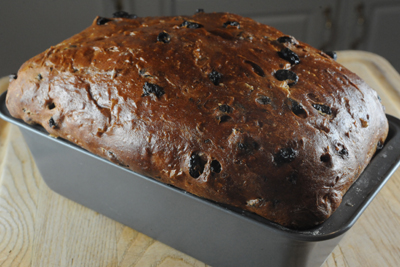
The lassy bread was really good. The kids had it for breakfast the next morning and I think they even took some of it to school to have with their lunches. We ate it with butter but it would have been totally fine without butter, too. It was a really nice versatile bread—easy to make and delicious.

So that's Eastern Canada, ay? (Sorry.) Next week: Ecuador.

For printable versions of this week's recipes:


Copyright 2023 Becki Robins and Palfrey Media.. Powered by Blogger.

Blog Flux

Blog Directory