Recipes from Marche, Italy

For this entry, I made two recipes. Neither of them were especially good, but I don't blame the people who posted the original recipes or any of the traditions they came from, I blame myself and my propensity for Googling things that might kill me.

Recipes from Marche, Italy: Brodetto

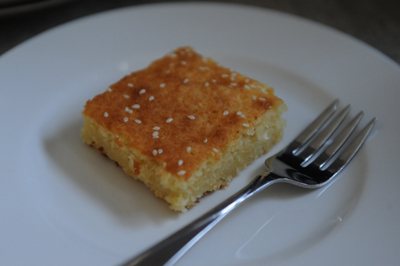
A seafood stew with mussels and clams, minus the Vibrio.

Recipes from Marche, Italy: Filone Casereccio

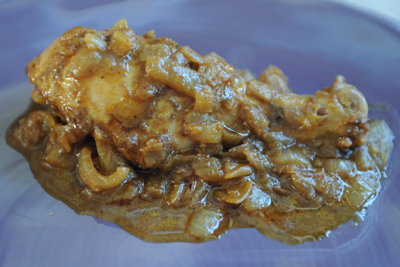
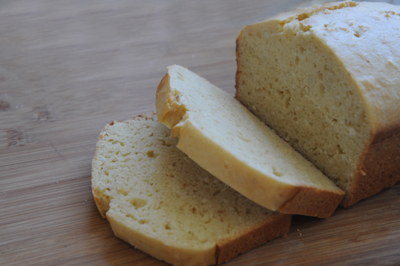
An Italian bread that will come out much better than mine did if you use fresh brewer's yeast and steam.

Recipes from Malta

This is actually the third time I’ve cooked a meal from Malta. The first time, I cooked the meal and then just did not write the blog post. Years went by.

Recipes from Malta: Imqarrun

Imquarrum (also called Imqarrun il-forn) is descended from a dish served in Sicily, but the Maltese have adopted it as a traditional staple. The key to making this dish is to be patient.

Thursday, January 9, 2014

Recipes from Heard Island and McDonald Islands

What do intrepid explorers eat when visiting remote Antarctic islands? If you guessed canned food, you're right! This week is an ode to that very non-gourmet meal: tinned, processed and frozen. And also botulism.

Uh ... yum?

Yes, botulism. I know what you're thinking: Wow, Becki, that's a really appetizing way to start a food blog entry! Don't worry, no one here has botulism. But I think about it every time I buy imported canned food, because I am one of those people who Googles every unlikely thing that might harm my children and then obsesses over it for unnecessarily long periods of time.

This week it was the canned corn beef, which is shockingly expensive--like six bucks a can expensive, and I needed two of them. Happily, I found canned corned beef at the grocery outlet for about half price. Sadly, I noticed after I already bought it that it was imported from South America, and then I started to wonder if the particular South American nation it hailed from had the same food safety standards that we do, and then I learned that said South American nation also had a recent case of mad cow disease that they tried to hide from the world and that gave me something else to worry about.

Curse you, Google.

Anyway, buy American corned beef for this meal. Unless you aren't unreasonably paranoid to the point of it probably being clinical.

So now I guess we have to stop talking about botulism and bovine spongiform encephalopathy and start talking about why I had to buy corned beef. Because our nation du jour is Heard Island and McDonald Islands, which is another one of those tiny, uninhabited places. This particular island group is an Australian territory located about two thirds of the way from Madagascar to Antarctica, though it is technically in the Indian Ocean. It's roughly 144 square miles and is home to the only two active volcanoes on Australian territory. Historically it was a big sealing settlement, furnishing more than 100,000 barrels of elephant seal oil to the world over a period of about 25 years, until the sealers wiped out all of the seals. Today the seal population on the islands is protected and most species are bouncing back. Those seals are the only mammals that are tough enough to call the islands home, besides the occasional human.
Satellite image of the southern tip of Heard Island. (Image source: NASA)
With the holidays so recently behind me, I actually didn't have a lot of energy to go chasing down scientists and other people who'd spent time on Heard Island and the McDonald Islands. Fortunately, I found a book that provided me with some details about what past visitors have eaten there in the past, this one: Unique & Unspoilt: A Year Among the Natural Wonders of Heard Island (edited by Bernadette Hince). The book details a year-long expedition to Heard Island in 1953, and lists rations and a few dishes that the visitors ate during their time there. 
 
There were no recipes of course, so I tracked down some Australian versions of the dishes and rations listed and came up with this oh-so gourmet menu:

Bully beef stew
(This recipe comes from Mouths of Mums)
  • 2 cans corned beef
  • 2 beef stock cubes
  • 2 potatoes
  • 2 carrots
  • 1 cup frozen corn
  • 1 cup flour
  • 1 tsp baking powder and a small amount of water

Australian Whole meal biscuits
(From a website called "The Discount Travel Site")
  • 1 1/4 cup whole wheat flour
  • 1/2 cup all-purpose flour
  • Pinch salt
  • 2 tbsp sugar
  • 2 oz butter
  • Pinch baking soda
  • 1/2 cup warm milk

Pineapple Betty
(This is an old recipe published on joyofdesserts.blogspot.com)
  • 1 1/2 cups crushed pineapple
  • 1 cup soft bread crumbs
  • 3 tbsp sugar
  • 3 tbsp butter
  • 1/4 tsp cinnamon
  • 1/2 cup pineapple juice

The good news is, food out of a can is easy to prepare. Here's how to make the stew: 

First peel and dice the carrots and potatoes. Make sure the carrots are cut into suitably large chunks so you don't have to eat them.

Now boil the potatoes and carrots with the stock cubes and enough water to cover until they are almost cooked through. 

Now, I also put my beef in at this point because of the whole stupid botulism thing (botulism toxin is destroyed by high temperatures) but my beef disintegrated, so I don't recommend this if you are reasonably sure your corned beef is botulism-free.

Next, mix the flour with the baking powder and add enough water to make "doughy chunks." What you're doing, really, is making some very basic dumplings to put in the stew. 
 Now add the corned beef and the frozen corn and heat through. In the last five minutes, add the "doughy chunks" and let them cook until they're puffy. All done!
Meanwhile make the biscuits. First, preheat your oven to 375 degrees. Sift together the whole wheat flour with the all purpose flour and salt. 

Add the sugar. Now melt the butter and stir in the warm milk, then blend with the dry ingredients until you get a nice soft dough. 

Roll into a 1/4 inch thick sheet and cut into rounds with a biscuit cutter. Transfer to lightly greased baking sheet and bake for 20 minutes or until golden.
Now make the dessert, which is super simple: just mix the pineapple with the bread crumbs, sugar, cinnamon and juice. 
Transfer to a buttered baking dish and dot with pieces of butter. Bake in that same 375 degree oven until golden.
Now you're eating like the king of Heard Island and McDonald Islands, of which there is no actual king so interpret that how you want to.

Here's what we thought: the stew looked downright nasty. I'm not going to describe it, because you've seen the picture. But it looked gross. When Martin saw it he made a sound that I can only describe as a mortified grunt.

But it didn't taste bad. It was actually pretty decent tasting, in fact. Definitely not something I would expect at a four star restaurant, or even a two star restaurant, but perfectly edible. Martin went back for seconds so there you go. The biscuits were also perfectly pleasant, especially with a little honey though they didn't need it since they were already sweet. And the pineapple Betty was fine, too, in fact as far as desserts go it was quite a nice switch from all that rich chocolate stuff we've been eating for weeks.

So yeah, it was fine. And you have to admit it at least made for an entertaining entry, I hope. And no one got botulism, either.

Next week: the Holy See (Vatican City)
For printable versions of this week's recipes:

Thursday, January 2, 2014

Recipes from Haiti

Hey! Welcome to 2014, and the H’s. We’re opening up a new year with a new letter of the alphabet, how’s that for a clean slate?

I hope your holiday was lovely, and that you’re not dreading the first half of the year like I am. Because for me, it’s birthday party planning just about every month until May. I’d say my least favorite thing about being a mom is birthday party planning. So, I’m just going to put it out of my mind and tell you about Haiti instead.


If you’re up on current events the first thing that probably pops into your head when you hear the name “Haiti” is that 7.0 earthquake of 2010, which devastated an already suffering population. Haiti is a poor nation, and as with many poor nations it has an unstable government that was wholly unprepared to handle the aftermath of such an event.

So most of us on the outside have probably been rightfully fixating on that quake and its impact on Haiti, forgetting entirely the inspiring early history of that nation. Haiti was the first independent nation in Latin America and the Caribbean—but most importantly, it was the only nation in the whole world that was established after a successful revolt by slaves. In fact, all of Haiti’s original leaders were former slaves. That’s pretty cool, and it’s a great legacy for this small Caribbean nation.

 Fort St. Joseph - Fort-Liberté, Haiti. Photo by Nick Hobgood.

Sadly, Haiti doesn’t benefit as much as it ought to from its location in the Caribbean, at least not as far as the tourism industry is concerned. That’s because Haiti is not really a safe place for tourists, who sometimes get kidnapped or murdered while on holiday there. So tourists often prefer neighboring Dominican Republic, and then of course they miss out on the food.

Haitian food is good. Its style is a blend of French, African and Taíno (the aboriginal population), and it’s flavorful. It’s Caribbean, but with it’s own flare.

Here are the two recipes I chose for my culinary trip to Haiti:

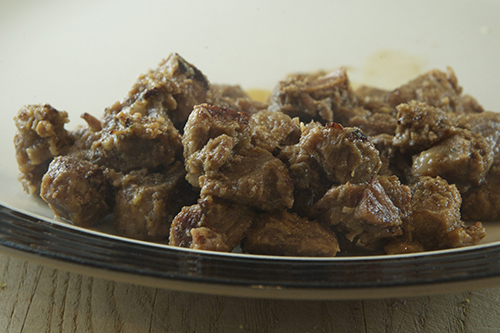
Tassot (stewed meat)
(from Everything Haitian)
  • 2-3 lbs beef or goat, cut into bite-sized pieces
  • 1/2 cup orange juice
  • 1/4 cup lime or lemon juice (I used lemon)
  • 1/2 cup vegetable oil
  • 1 tsp parsley
  • 1 tbsp garlic, minced
  • 1 tbsp onion powder
  • Salt and freshly-ground black pepper to taste
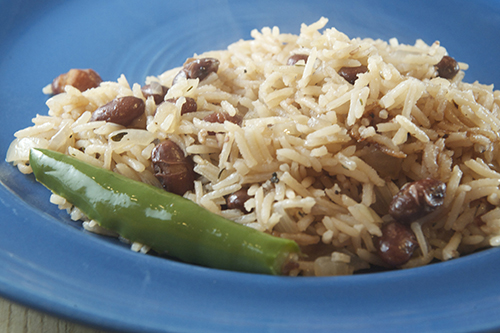
Diri kolé ak pwa (beans and rice)
(from Kreyol Cuisine)
  • 3 cups basmati rice
  • 1 cup red beans
  • 8 cups water
  • 5 tbsp oil, divided
  • 1 tsp margarine
  • 1 large onion, diced
  • 3 cloves
  • 3 cubes chicken stock
  • 1 hot pepper
  • 2 chopped shallots
  • 2 cloves garlic
  • 1 tsp salt
  • 1 tsp ground pepper
  • 1/2 tsp thyme
I also bought the ingredients for a dessert called “Bonbon Sirop,” but in the end decided not to make it. Honestly, I’m sick of sugar. I know, I bet you never thought you’d hear me say that. But after several weeks of fudge, pie, cakes and cookies I really am done with sweets for a while. So if you decide to make Bonbon Sirop, please let me know how it came out, because I don’t think I’m going to get around to it any time soon.

The two recipes I did make were really easy. Here’s how, starting with the tassot:

Now, I did not use goat for mine even though I have some in my freezer. In retrospect, goat would have been great for this dish because you can cook it for as long as it takes to get a tender meat. My goat is all on the bone, though, so I would have had to endure my husband moaning about “booby-trapped meat,” as he often does. So I used stew beef instead. But really, I think you could do this in a crockpot with even a tougher bit of goat and it would be delicious.

OK, first put all the ingredients except for the vegetable oil in a large bowl. Toss and let marinate in the fridge for 3 or 4 hours.

Now move the whole lot to a pot and add just enough water to cover. Bring to a boil, then reduce heat. Cover and let simmer until the meat is tender.

Now heat the oil in a large frying pan. Remove the meat from the pot with a slotted spoon and fry it in the oil until it’s golden brown all over. I know, this seems backwards, but it works. Trust me.

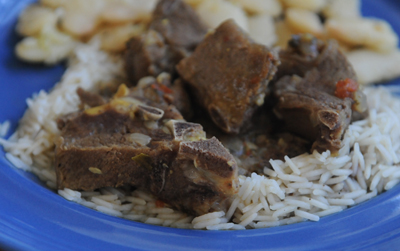
It doesn't look very exciting, but it really is very tasty.

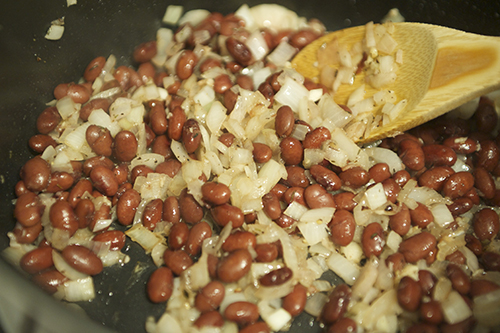
Now for the beans and rice: First rinse the beans and transfer to a large pot with 8 cups of water and a tablespoon of the oil. Bring to a boil and cook for an hour or two, until they start to split. Drain but keep the cooking water.

Heat 3 tablespoons of the oil in a large frying pan and saute the onions, garlic, and shallots until they start to soften. Add the spices, the red beans and the stock cubes.

Now add 6 cups of liquid from the beans (I didn’t have that much left over, so I had to top it off with water). Bring to a boil, then add the rice and the hot pepper.

Cook uncovered over low heat until all the water has been absorbed. Now add the last tablespoon of oil and the butter. Cover the pan and make sure the flame is on a medium-low setting. Cook for another 15 minutes. Have faith! I know it seems like you’re going to burn the rice, but you’re not. You’re going to get a nice golden crust on the bottom and rice that is the most perfect texture ever.

Now, let me preface this by saying that I used to only ever boil rice. After doing this blog for a few years I now understand that boiling is the dumbest way to make rice. Sure, you get edible rice but you can’t get that wonderful, fluffy texture unless you make it in the above (or similar) manner.

My rice and beans came out perfectly. In fact I almost cried when I realized that the leftovers had been buried under a bunch of holiday leftovers and forgotten about, and I had to throw them out. Because this was probably one of my life’s top five beans-and-rice experiences. It was flavorful, but that texture, oh-my. You just can’t underestimate the importance of good texture in food.

The meat was also very delicious. Mine was a little dry, but that was my own fault for not keeping it topped up with water. Like I said, I think I would do this again in a crockpot. The flavor was really good and the crockpot would make a tender beef (or goat!) without drying it out too much.

So there you go, the first TbS meal of 2014—and it was a good one! I love when things start off well.

Next week: Heard Island and McDonald Islands

For printable versions of this week’s recipes:

Tuesday, December 24, 2013

My favorite world recipes of 2013

Well here we are at the end of another year, and I'm posting my list of favorite recipes from 2013. Didn't I just do this a couple of weeks ago? Oh, it was a whole year ago. Imagine that.

I love doing these posts actually because they give me a chance to refresh my memory. I cook a lot of interesting food for my blog and sometimes I lose track of the stuff that was really outstanding. Which would be a shame, because the dishes I'm about to list are worth putting in anyone's permanent recipe rotation.

Ready? Here we go:

Ecuador: Llapingachos

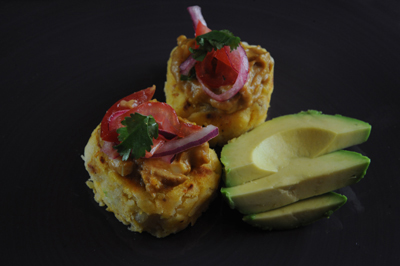
These little potato patties are pretty stinking good, especially topped with a peanut sauce called salsa de mani and an onion curtido (both recipes included in that post). When I made these llapingachos they turned out perfectly, even though I'm hopeless at any sort of pan-fried patty thing. I served them as a side but I could see these done as appetizers, too.

El Salvador: Quesadilla Salvadorena

This is not your local Chevy’s Restaurant quesadilla, nor is it like any other quesadilla you are likely to get anywhere in the US, unless you visit an El Salvadorian restaurant. This quesadilla is more like a cake, and is in fact served as a dessert. It’s sweet but also cheesy, and that’s a heavenly combination. Who knew? Well sure, there’s cheesecake … but cream cheese is meant to be sweet. Parmesan, on the other hand—it was unexpectedly delicious in this lovely dessert.

Ethiopia: Doro Wat

I might have actually given Ethiopia a nod on this list even if this hadn’t been one of the big highlights of my culinary year. You see, for the past decade and a half I’ve been living a lie—the lie that said I don’t like Ethiopian food. Now, this was based entirely on one bad restaurant experience so even I know how unfair that is. Fortunately this recipe for Doro Wat changed my mind about Ethiopian food. It’s a delicious, rich, flavorful stew that you really have to try.

Europa Island: Massala Cabri (Goat Curry)

Now, you may be surprised to see this one on the list and I’ll admit that I chose it more for the experience of researching it and writing the post than for the dish itself. It was a very good recipe, but sadly my goat was a bit tough. Still, the great story that came along with this recipe made my Europa Island meal one of the most memorable of 2013.

Fiji: Coconut Bread

Wait just a second while I bask in the memory of this coconut bread. Mmmm, this was really good. You could have it for breakfast with a cup of coffee, or after lunch as a dessert, or, you know, instead of dinner. It was seriously that good.

Gascony and the Basque Country, France: Gâteau Basque

Yes, I know there are a lot of dessert recipes on this list. What can I say, I made a lot of yummy desserts this year, and this was one of the best. It was buttery and rich and filled with decadent black cherry preserves. I could probably eat a whole cake all by myself and never feel an ounce of guilt about all that butter.

Grenada: Roast Pork Calypso Style with Black Bean, Heart of Palm and Corn Salad

This pork and salad recipe was a meal all by itself, and not only did it look beautiful, it also tasted that way. I served it on the same platter we use for our Thanksgiving turkey and it felt like we were having a holiday feast. Between the six of us we devoured a whole roast in less than 10 minutes and I had enough salad left over for lunch the next day.

Guadeloupe: Bokit au Poulet

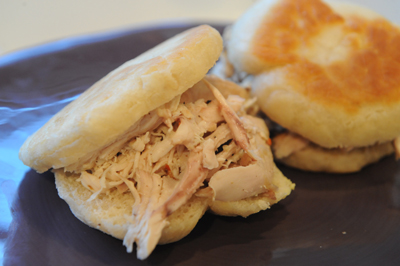
This was a really simple dish made with a roasted chicken and fresh baked bread rolls. I could have eaten a lot of these and I really wish I’d made more. The roast chicken recipe all by itself was a good one and you actually could stop there if you don’t want to go to the trouble of making the bread. But hey why give yourself only half of a good thing? Fresh baked rolls with roasted chicken, what’s not to love?

Guam: Chicken Kelaguen

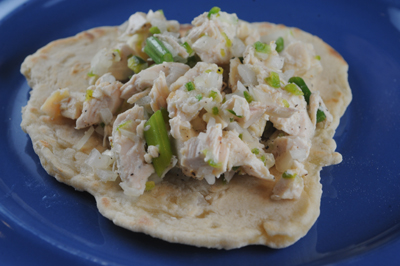
There are a lot of reasons why I love chicken kelaguen, and it’s not just because it tastes good. It was also really easy to make—proving once and for all that not every blog night has to be a back-breaking, hours-long cooking fest. Kelaguen can be made with unseasoned chicken cooked pretty much any way you like—grilled, steamed in foil or even just one of those rotisserie chickens from Safeway. Most of the flavor of this dish comes from what you mix it with. And it’s awesome on the slightly sweet coconut rotis I made to go with it.

Guernsey: Guernsey Biscuits

Whenever I open up a can of refrigerator biscuits I scream and jump halfway across the kitchen. I hate when they pop, it scares the hell out of me. So I was happy to find this recipe, which makes a delicious biscuit (with yeast!), no fiddly rolling technique required and no terrifying explosion necessary.

Actually I really liked the dessert I did from Guernsey, too, but I’m not going to go there again. You should check it out, though.

Yes! That’s the best of this year with Travel by Stove. Merry Christmas to all and a happy New Year too!

PS Did you try any of these recipes? What did you think?

Thursday, December 19, 2013

Recipes from Guyana

Some people like to shoot deer. Me, I wish I liked to shoot them, because they keep eating my tomatoes. I don't have it in me, though. Deer are too beautiful. Of course, around here they are like pigeons, except there are more of them and they're only about half as useful.

I was going somewhere with this, where was it? Oh yeah, people like to hunt. Everyone does, even those of us who don't like to hunt animals. We like to hunt other things, like maybe a bargain or that rare penny to add to a coin collection or maybe sea glass on the beach. Me, I like to hunt for exotic ingredients. And also sea glass on the beach.

So that's why I've had a bottle of cassareep in my pantry for the last maybe year and a half. Because it was that long ago that I decided to make pepperpot when I got to Guyana, mostly so I could go hunting for that critical ingredient. Cassareep was not easy to track down and when it arrived it had leaked all over the inside of the box, but damn it, I'd bagged me some cassareep. And that's where it's been sitting for the last 18 months.

So yeah, Guyana. It is the world's 500 billionth Caribbean nation. Sorry, that's just me being cynical, because I've made a lot of Caribbean food in the last couple of years. Anyway, Guyana is actually distinct from most of the other 499 billion 999 thousand 999 Caribbean nations in that it is not an island, but rather a country on the northern coast of South America.


I hate to just hone right in on the notorious stuff, but you know it makes for better reading than "British colonization followed by independence followed by blah blah." If you know anything about Guyana you know where I am going with this: Jim Jones. Yes, sadly this nation was the site of that notorious cult suicide of 1978, when cult leader Jim Jones ordered 918 people (including more than 300 children) to drink a concoction of cyanide-laced Kool-Aid. Which they did. That event went down in history as the "greatest single loss of American civilian life in a deliberate act," a title it held until September 11, 2001.

 Kaieteur Falls from Potaro. Canyon, Guyana. Photo by Alan Hopkins.
So now that I've brightened your day, let's get on to the food. Guyanese food is pretty typically Caribbean; a mixture of African, creole, Amerindian and British influences. The Guyanese enjoy curry and roti as well as typical Caribbean-style peas and rice. And, of course, pepperpot.

Here's that recipe:

Pepperpot
  • 2 lbs stewing steak (pork or beef) or brisket
  • 2 pigs' feet (optional)*
  • 2 lbs oxtail
  • 1 cup cassareep
  • 2 red hot peppers
  • 1-inch cinnamon stick
  • 3 whole cloves
  • 2 oz sugar
  • Salt to taste
  • 2 sprigs basil
  • 1 bunch thyme
  • 1 large onion, chopped
  • 3 cloves garlic, chopped
* The pigs' feet will help thicken the stew. I left them out of mine, because ew.

And something to mop up the juices:

Dahl Puri

For the filling:
  • 1 tsp salt
  • 1/4 tsp turmeric
  • 2 cloves garlic
  • 1 tsp ground cumin
  • 2 cups yellow split peas
  • 1/4 of a scotch bonnet pepper
For the dough:
  • 3 cups all purpose flour
  • pinch fast acting yeast
  • 1/4 tsp salt
  • 2 tbsp baking powder
  • water
  • 5 tbsp vegetable oil
And also a dessert, because I just couldn't resist:

Salara (Red Coconut Cake)
  • 1 tbsp dry yeast
  • 1/4 cup warm water
  • 1 tbsp plus 1/4 cup brown sugar
  • 1 cup milk
  • 1/4 cup butter, melted
  • 1 tsp salt
  • 3 cups flour
  • 1 egg, beaten
  • 1 egg, separated
For the filling:
  • 3 cups sweetened, shredded coconut
  • 1/2 tsp cinnamon
  • 1/2 tsp vanilla extract
  • 1 tbsp red food coloring
For the glaze:
  • 1/4 cup granulated sugar
  • 1/2 cup water
Let's make the cake first. It's actually a lot simpler than it looks.

First dissolve all that yeast in warm water with a tablespoon of sugar. Let it stand for 10 minutes or until frothy. Now gently heat the milk until warm and add the rest of the sugar, stirring until dissolved. Whisk in the butter and egg.

In a separate bowl, sift the flour together with the salt. Add the yeast mixture along with the milk/butter and mix thoroughly, preferably with an electric mixer. Now pour in the flour and keep mixing until you get a soft dough.

Now, I don't really know what went wrong with mine. It wasn't a dough, it was a batter. That could have been because I measured something wrong. Something terribly, terribly wrong. But it could also be because the recipe was wrong. I do intend to try again and will post an update when I know for sure--but in the meantime if you make this recipe do tell me what your results were.

Anyway I just turned my batter into dough by mixing in maybe another half cup of flour (just keep adding it until you get a soft, bread-like dough).

Ok now knead your dough ball on a floured surface or let your bread machine do it. Butter a bowl and transfer the ball to it, then cover with a damp towel. Let rise for an hour or until doubled in size.
Meanwhile, combine the ingredients for the filling and set aside.


Now turn the risen ball out onto a large, floured surface. Punch down, then roll into a large rectangle shape . Brush the edges with the egg white and then spread that bright red coconut filling evenly over the dough, almost but not quite to the edges.

Now roll the dough lengthwise into a log shape and seal the edges.

Brush with the egg yolk, cover loosely with plastic wrap and let rise for maybe another hour.

Bake at 350 degrees for 20 or 30 minutes or until a beautiful golden color.

During the last 10 minutes of baking, make the glaze. Dissolve the sugar in the water and heat in a small saucepan until boiling. Boil for 5 to 10 minutes. Brush over the finished Sahara and then let cool. Devour.

OK now let's do the Dahl puri. I was pretty seriously intimidated by this recipe but it really wasn't that hard, just wordy. I'm going to try to edit it down to make it seem a little less scary.

First rinse the split peas. Meanwhile, boil 5 or 6 cups of water in a large saucepan and add the peas, salt and turmeric. Reduce heat and let boil for 20 minutes or until soft. Drain and let cool.

Meanwhile make your dough. Mix the flour with the salt, yeast and baking powder. Add water until you get a firm dough. Shape into a ball, cover with plastic wrap and let rest for 20 minutes.

Transfer the cooled peas to a food processor and process until they look kind of like bread crumbs. You should have no whole peas remaining.

Divide the dough into six smaller balls. Flatten the first one and then shape into a sort of shallow bowl. Dust with a little bit of flour and then fill with some of the split pea mixture. 

Now fold over the edges and pinch together to seal. You should end up with a good sized ball. Repeat until you have six split pea filled balls.

Ok here's the tricky bit. Put one of the balls on a floured surface and then very gently roll it flat. If you've done everything right, your disk should be about 12 inches wide and an eighth of an inch thick and none of the filling should burst through the dough. Miraculously, this actually came out right when I did it, though I think my dahl puri were a bit smaller than they were supposed to be. I do think this is probably the first time I've done a recipe like this and not had it turn into a pathetic mess.

Continue until all the balls are rolled flat. Then heat some oil in a large, nonstick skillet and cook for about 30 seconds on one side. Flip, brush with oil and cook for another minute or so. Repeat until your dahl puri is starting to puff up and turn golden.

Now for the pepperpot. If you’re using pigs’ feet you’ll need to boil those first until about half cooked, skimming that yucky stuff off the surface of the water. No I don’t mean the whole pigs' foot.
Add the rest of the ingredients and make sure they are covered with water. Now, the recipe didn’t say what to do with that pepper, so I just dropped it in whole. But my result really didn’t have a lot of pepper flavor so I wonder if that was the right move. I think if I had it to do over I would chop the pepper up instead. Whatever you choose to do, bring to a boil, then reduce heat and simmer until the meat is tender.

Add some salt and sugar to taste. Easy-peasy.


So now that I’ve finally had a chance to use that cassareep I worked so hard to obtain and which sat in my kitchen cabinet for all those months, what did I actually think about the pepperpot?

Well, it was OK. I liked it well enough, but to be honest the cassareep just tasted like molasses. In fact I think you could probably get away with just using molasses in your pepperpot and you wouldn’t really know the difference. The whole dish was really sweet and could have been spicier. I think I was right, that pepper probably should have been chopped up.

Now, I do have to wonder if maybe my cassareep was the right stuff. Wikipedia describes cassareep as the “bitter exctract of cassava,” and it really didn’t taste all that bitter to me. I wonder if it’s usually made with molasses or if that was just for the benefit of the American market. Oh well, unless a Guyanan emails me with the answer, I guess I’ll never know.

I did like the dahl puri. I liked it a lot, though I would add a little salt to the split peas if I made it again. They really came out shockingly perfect and they tasted very good, though they do fall apart if you try to tear into them vs. just biting into them whole.

Now for that cake, oooh it was really good. The glaze gave it just enough sweetness on the outside but it was really quite sweet and coconutty on the inside, too. I swear I gained at least two pounds eating this stuff because the loaf was enormous. I didn’t hoard it, either; everyone in my family was stuffing themselves with it.

So yes, very good overall, especially the bread and the dessert. As for the cassareep, well, I didn’t use it all and it went back into the cabinet. Where I suppose it will stay for another 18 months. At least.

Next week: I'm posting my list of favorite recipes for 2013! I'll get back to nation-hopping the week after.

For printable versions of this week's recipes:

Thursday, December 12, 2013

Recipes from Gujarat, India

When I was about 19 I went through that phase that I’m pretty sure at least half the American population of teenage girls goes through. I went vegetarian.

I know, it’s hard to believe, what with my current carnivorous ways. But for almost 10 years I managed to stay away from meat almost completely. I’d eat fish and I’d usually have some turkey on Thanksgiving and Christmas, but that was it. Then I met my uber-carnivorous husband and that all went completely out the window. So did my 115 pound vegetarian body.

I think I’ve been trying to make up for all that lost time. I can definitely say that today, my family eats too much meat. We should have at least one day a week where we have a meatless dinner, not just for health and ecological reasons but also because, well, it’s a lot cheaper. But we don't.

So there’s nothing like a delicious, totally-vegetarian meal to remind me of all this. Of course, I had to mail order a couple of exotic ingredients for this one so I’m pretty sure there was nothing ecological about it considering all the jet fuel that had to be burned to get it into my hands. But there you go.

Why vegetarian? Because this week’s location is Gujarat  in north-western India, where they just don’t eat very much meat. This is primarily because of the influence of Jain vegetarianism and the large population of Hindus who live in Gujarat. Jains object to the consumption of most animal products because harming an animal (either directly or indirectly) is considered an act of violence, and violence gets punished by karma.

Gujarat is the homeland of India’s most famous Hindu, Mahatma Gandhi, who led the Indian Independence Movement against British colonial rule in the early part of the 20th Century. It was also a key player in the growth of the Indian economy and is today one of most industrialized states in India, with a GDP that is well above the national average.

The Sun Temple, Modhera, Gujarat. Photo by Umang Dutt.

Gujaratis eat a lot of rice, dal (split beans such as lentils) and roti (flatbread). Main dishes are vegetable based and are often both sweet and spicy. I chose three recipes for my meal:

Baby Potatoes In Spicy Yogurt Gravy
(from Sanjeev Kapoor)
  • 20 unpeeled baby potatoes
  • 1/2 cup low fat yogurt
  • A pinch asafoetida*
  • 2 tsp garlic paste
  • 2 tsp ginger paste
  • 2 tsp red chilli powder
  • 1/2 tsp turmeric powder
  • 2 tsp coriander powder
  • 1 tsp cumin powder
  • 1/2 tsp garam masala powder
  • Salt to taste
  • 2 large onions, chopped
  • 2 tbsp cilantro, chopped  
* Another odd spice you’re not going to find at Safeway. I got mine from Amazon.com.

Toovar Dal Ni Khichdi
(from tarladalal.com)
  • 1 cup toovar dal*
  • 1 cup rice
  • 1 tbsp ghee
  • 1/2 tsp cumin seeds
  • 2 cloves
  • 5 black peppercorns
  • 1 stick cinnamon
  • 1/2 tsp turmeric powder
  • Salt to taste
*Toovar Dal is a split pigeon pea. If you have an Indian market in your area, you may be able to buy it there. Otherwise you can order it from Amazon.com.

Besan Ki Masala Roti
(also from Sanjeev Kapoor)

For the roti:
  • 1 cup gram flour (besan)*   
  • 1/2 cup whole wheat flour  
  • 3/4 tsp salt
  • 1/2 cup water
  • 2 tbsp ghee   
For the  filling:
  • 1 1/2 tsp cumin powder  
  • 1/2 tsp coriander powder 
  • 1/4 tsp turmeric powder   
  • 1 green chilli, chopped  
  • Salt to taste
  • 1/2 tsp mango powder (amchur)  
  • 1/2 tsp red chilli powder   
  • Ghee   
* This is chickpea flour. Bob’s Red Mill makes it—if you can’t get it locally, you can also buy it from Amazon.com. Don’t substitute, though, because chickpea flour has a very distinct flavor and texture.

Let’s do the dal first. Note: the instructions were for cooking in a pressure cooker, which I do happen to own. I think you could just as easily do it on the stovetop, but I’m unsure of how much time it would take so the directions I’m including here are for the pressure cooker.

First, mix the dal with the rice and cover with water. Let soak for 30 minutes. Drain and set aside.

Now heat the ghee in your pressure cooker. When it’s hot, add the cumin seeds, cloves, peppercorns and cinnamon. Wait until you hear them start to pop, then add 3 1/2 cups of hot water, the rice, the dal, the turmeric powder and salt. Mix well and cover.

Cook on medium-high for about 12 minutes. What you’ll end up with is a kind of mashy looking substance that doesn’t resemble either rice or dal. Based on the photos from the original recipe, I’m pretty sure that’s what it’s supposed to look like. :)

Meanwhile, make the potatoes. First you’ll need to parboil them until they are just tender. Drain and set aside. Now mix the yogurt with the asafoetida, garlic and ginger pastes and spices. Once the potatoes have cooled a little, add this mixture and toss until well-coated. Let marinate for about 30 minutes.

Saute the onions in a separate pan until golden, then add the potatoes and marinade.

Heat on high and then reduce heat and simmer for 10 or 15 minutes, until the sauce thickens and the potatoes are cooked all the way through. Garnish with chopped cilantro (damn, I always forget to garnish).

And finally, the roti. First make the filling by mixing all those ingredients together in a small bowl. Set aside. Now mix the roti ingredients and knead until you get a soft dough.

Divide into eight portions and roll into balls. Flatten with a rolling pin or your hand and spread 1/8th of the filling onto the disk.

Fold in half, then fold in half again, then roll until you have a sort-of triangle shape. Repeat with all the dough balls, using up the remaining filling.


Heat some ghee in a pan and fry the roti on both sides until golden. Brush a little bit of melted ghee on both sides and then serve.

So, the potatoes were a lot spicier than I expected them to be and my poor children were traumatized. The good news is they all got plenty of water that day. I loved these potatoes and would gladly make them again, 'cause spicy food makes me happy. I enjoyed the dal, too, but it was quite stodgy and my kids wouldn’t go near it. I would put more salt in it if I made it again because the flavors were a little too subtle.

Martin was a huge fan of the roti, which was a nice change from flour-based rotis and was made even more interesting with the flavorful filling. It was great for mopping up that spicy yogurt sauce from the potatoes, too.

Hey guess what, there’s only one more “G!” That’s (nearly) seven letters down, 19 to go. Haha.

Next week: Guyana

For printable versions of this week’s recipes:


Copyright 2023 Becki Robins and Palfrey Media.. Powered by Blogger.

Blog Flux

Blog Directory